

PTSD and anxiety can feel almost the same from the inside. Both can leave you tense, sleeping badly, quick to startle and quick to snap. The clearest difference is the starting point. PTSD begins after a frightening or life threatening event, and the mind and body keep reacting as if the danger is still here. Generalized anxiety, the form people usually mean when they compare the two, is ongoing worry about many parts of life, and it doesn’t need one event behind it.
Doctors distinguish them in regard to time as well. PTSD is diagnosed when, after a traumatic event, symptoms last more than a month and cause significant trouble in a person’s everyday activities. Generalized anxiety is diagnosed when worry occurs on most days for a continuous period of six months or longer, and is difficult to control.
What is PTSD?
For PTSD, or post traumatic stress disorder, a person may experience a terrifying event, and their mind and body continue to believe that the danger is present. Events that may cause PTSD to occur include things like assault, abuse, and accidents, as well as things like the unexpected death of a loved one, and war. Symptoms may hold on for the rest of a person’s life, and are more common in women than in men.
- Intrusive memories. Unwanted memories keep returning. Some people have flashbacks or nightmares, and a reminder can bring on strong distress or a racing heart.
- Avoidance. You steer clear of conversations, places, people or activities that remind you of what happened, and often avoid thinking about it too.
- Negative changes in thinking and mood. Harsh beliefs about yourself or the world, constant guilt, shame, fear or anger, losing interest in things you used to like, feeling cut off from others, and trouble feeling anything positive.
- Changes in how the body reacts. Being easily startled, always watching for danger, irritable, unable to concentrate or sleep. Some people have angry outbursts or take risks they normally wouldn’t.
If you want to understand what sets these reactions off, understanding PTSD triggers goes into it. Trauma from early life can look different, which complex PTSD vs PTSD explains.
What is generalized anxiety disorder?
Everyone worries. Generalized anxiety disorder, or GAD, is worry that is bigger than the situation deserves, hard to control, and spread across lots of areas of life. Adults often worry about work, health, money and family, and children and teens more often worry about school and friendships. Anxiety disorders also include panic disorder, social anxiety and phobias, but GAD is the one that most often gets compared with PTSD.
In the mind, GAD tends to mean imagining worst case outcomes, reading neutral situations as threats, struggling with uncertainty and decisions, and finding it hard to let a worry go. Many people keep asking others for reassurance.
In the body, it often brings tiredness, poor sleep, muscle tension, trembling, sweating, an upset stomach and a keyed up, on edge feeling.
GAD doesn’t need a traumatic event. It seems to come from a mix of genes, brain chemistry, how the mind judges threat, personality and stress, and it usually starts in early adulthood. For the everyday version of this, what anxiety feels like day to day is a good read, and generalized anxiety disorder vs worry draws the line between normal worry and the disorder. There’s also a broader look at anxiety disorders.
How do PTSD and anxiety compare side by side?
This table shows the patterns. It isn’t a way to diagnose yourself.
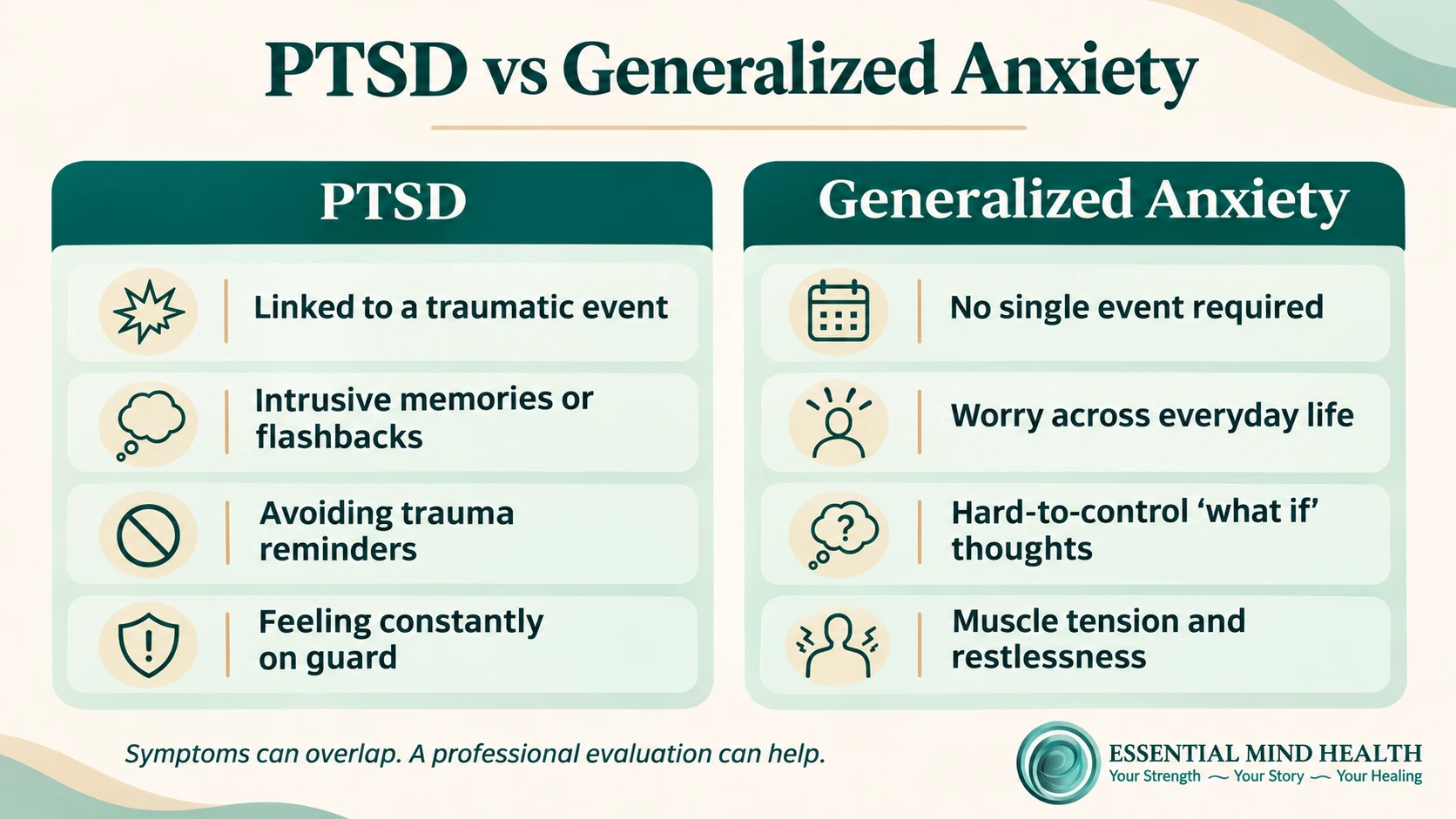
| PTSD | Generalized anxiety disorder | |
|---|---|---|
| What starts it | A traumatic event you lived through, witnessed or learned about | No single event needed |
| What the fear is about | What already happened, plus reminders of it | What might go wrong |
| Memories | Unwanted memories, flashbacks and nightmares | Worried thoughts, not replays of an event |
| Avoidance | Reminders of the event | Situations that set off worry |
| Mood changes | Guilt, shame, anger, feeling numb or cut off | Dread and restlessness |
| Body | Easily startled, always on guard | Tiredness, muscle tension, upset stomach |
| Sleep | Nightmares, trouble falling or staying asleep | A mind that won’t switch off |
| Timeline for diagnosis | Symptoms for more than a month after the event | Hard to control worry on most days for six months or more |
Is PTSD an anxiety disorder?
Health sources answer this differently. Some describe PTSD as an anxiety disorder, and others treat it as its own condition tied to trauma and stress. Either way the two are closely related and share many symptoms.
The practical difference is that PTSD has its own symptom pattern and its own timeline, so care for it focuses on the trauma. That focus is easy to miss when PTSD gets filed under “anxiety”.
Which anxiety and PTSD symptoms overlap?
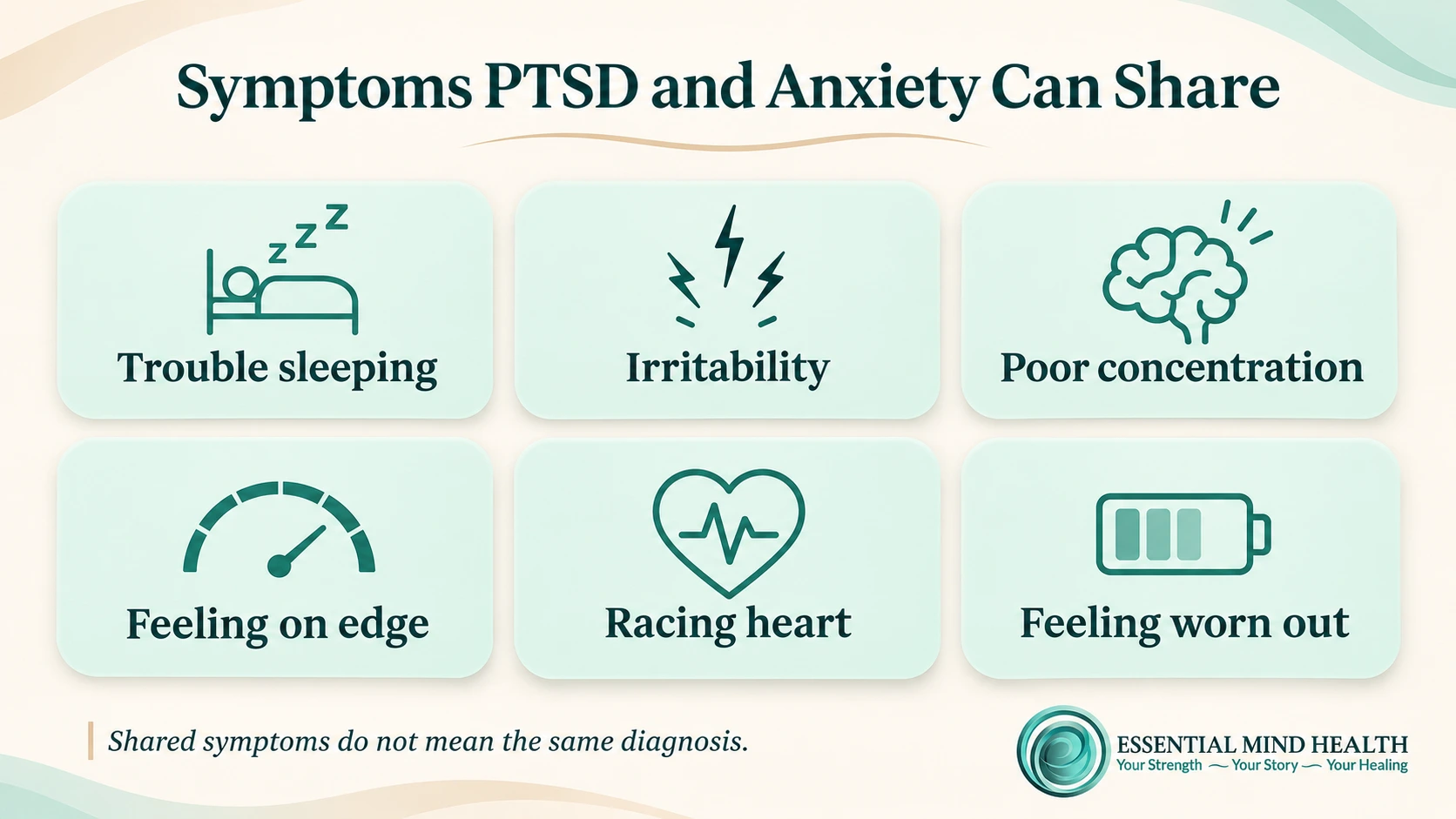
Quite a few. Trouble sleeping, irritability, poor concentration, feeling keyed up, being easily startled and a pounding heart show up in both. Both can also lead you to avoid things, and both can leave you worn out.
The reason is that the same alarm system is involved. In each condition, the body’s threat response fires more than it should. What changes is the trigger. PTSD reacts to reminders of a past event, sometimes small ones. GAD reacts to a general sense that something could go wrong, even with nothing dangerous in front of you.
Physical symptoms are a good example. Why anxiety causes physical symptoms explains how worry turns into a racing heart and tight muscles, and PTSD can produce the same sensations when something reminds you of the event.
How can you tell whether it’s PTSD or anxiety?
Consider the following questions to inform your understanding and to take stock of where things stand. They are not to be confused with a formal evaluation, but rather to give you a general sense of what’s what.
- Is there a particular event that you are fixated on or that your body responds to? If yes, PTSD may be the case. If your concerns are more about the future and do not trace back to a particular event, generalized anxiety is likely more appropriate.
- Consider how the fear or anxiety presents itself. With PTSD, an anniversary or something that reminds you of the event can cause a flood of emotions and symptoms to come over you in the blink of an eye. Things that prompt or cause anxiety, like a deadline, can generate feelings of anxiety, but unlike PTSD, the anxiety may rise and fall and be present over an extended period of time.
- What kinds of thoughts predominate? With PTSD, thoughts about the event tend to be “stuck” and or “racing” and may present itself in the form of an image or flashbacks, rather than, or in addition to, thoughts. Thoughts that predominate with anxiety tend to be about what ifs.
- How do you feel about yourself? With anxiety, it tends to be more of a “dread” rather than numbness or feeling cut off.
If you recognize yourself in the PTSD side of that list, PTSD care in Jupiter is where to start, and anxiety care in Jupiter covers the other side. If you’re not sure, an evaluation is built to sort this out.
Can you have PTSD and anxiety at the same time?
Yes, and it happens often. PTSD commonly occurs alongside anxiety disorders, depression and substance use, and people with GAD can also have PTSD, panic disorder, phobias or OCD. A person with both needs care that covers both.
Past experiences feed in. Trauma in childhood raises the risk of anxiety disorders, and having anxiety or depression before a trauma raises the risk of PTSD afterward. If low mood has joined in, depression and anxiety explains how those two travel together, and depression care in Jupiter is the page to read next. The wider effects of trauma are covered in how trauma affects mental health.
How long does it take for PTSD to show up, and when is it PTSD?
Feeling jumpy, numb or shaken in the first days and weeks after a scary event is normal. Many people have PTSD like symptoms early on, and most don’t go on to develop PTSD. Support from family and friends makes a difference during this stretch.
It becomes PTSD when symptoms last more than a month and cause significant problems at work, in relationships or in daily life. Symptoms usually begin within three months of the event, but they can start years later, sometimes set off by a stressful stretch or a reminder.
They also come and go, getting worse under stress or around anniversaries, then easing. Some people recover within six months and others have symptoms for a year or longer. Left alone, the effects can build, which long term effects of untreated PTSD describes in detail.
What raises the risk of PTSD, and what protects against it?
Some things make PTSD more likely after a trauma. A severe or long lasting event does, and so does being injured or watching someone else get hurt. Earlier trauma, especially in childhood, raises the odds, and so do having little support from family and friends, ongoing stress such as losing a loved one or a job, heavy alcohol or drug use, and a personal or family history of mental health conditions. Jobs with regular exposure to trauma, like military service or emergency response, carry more risk too. Blood relatives with anxiety or depression matter as well.
Other things work as protection. Reaching out for support helps, as does having a way to cope and feeling okay about what you did during the event. Being prepared to respond when something upsetting happens also lowers the risk. A brief course of therapy soon after a trauma, or steady support from loved ones, may stop normal stress reactions from turning into PTSD. Childhood trauma explains why early experiences carry so much weight.
How do PTSD and anxiety look in children and teens?
Younger children show these conditions through behavior more than words. Children under six who have been through something frightening may replay the event in their play, have frightening dreams, cling to a parent, start wetting the bed after being toilet trained, or stop speaking. Older children and teens tend to look more like adults, and they may also act out, feel intense guilt or have thoughts of revenge.
Generalized anxiety in young people usually centers on school, activities, friendships and the future. Many try to be perfect as a way to manage the worry, which can hide how much they’re struggling. A fear that keeps a child from school or daily life is worth raising with their doctor.
How are PTSD and anxiety diagnosed?
Both are diagnosed through an evaluation with a mental health professional, not a quiz. For PTSD, the provider usually starts with a physical exam to rule out medical causes, then talks through your symptoms and the trauma behind them, and may use questionnaires. A PTSD diagnosis generally requires exposure to actual or possible death, violence or serious injury, with symptoms lasting more than a month and affecting how you function.
For anxiety, the provider looks at how long the worry has been going on, how hard it is to control and which symptoms come with it, and also checks for physical causes. Because many people have both, a good evaluation looks at everything instead of stopping at the first match. What online mental health care looks like shows how that first conversation can happen from home.
How are PTSD and anxiety treated?
Talk therapy is the main treatment for both, and both respond well to it. The approach differs because the problems differ.
For PTSD, the treatment is psychotherapy, often a form of cognitive behavioral therapy. Exposure therapy lets you face trauma related memories and situations gradually and safely, which can ease flashbacks and nightmares. Cognitive therapy targets stuck thought patterns, like harsh beliefs about yourself or guilt over things that weren’t your fault. It often runs 6 to 12 weeks or longer, one on one or in a group. If the situation that caused the trauma is still going on, treatment works best when it deals with the situation and the symptoms together. How PTSD is treated and recovery from PTSD cover what this looks like.
For generalized anxiety, cognitive behavioral therapy is the most studied option and is widely seen as the standard. It teaches you to question worst case thinking and handle uncertainty. Acceptance and commitment therapy also has growing support, and healthy habits help but don’t replace treatment. Some people also use medicine for either condition, which is a separate decision to talk through with a prescriber.
If you’d like to know how therapy itself works, there’s how therapy works and the benefits of cognitive behavioral therapy.
What can you do while you wait for help?
A few habits make daily life easier with either condition.
- Look after your body. Keep a regular sleep schedule, eat regular meals and exercise. If sleep is the hardest part, sleep and mental health explains how the two feed each other.
- Cut back on caffeine and nicotine. Both can make anxious feelings worse.
- Skip alcohol and drugs as a way to numb things. It causes new problems and gets in the way of recovery.
- Refocus when anxiety spikes. A brisk walk or a hobby gives your mind something else to do.
- Stay connected. Spend time with supportive people, and think about a support group.
When should you get help?
Get help when symptoms interfere with your life. For PTSD, that’s disturbing thoughts about a trauma lasting more than a month, especially if they’re severe, or feeling unable to take back control of your life. For anxiety, it’s worry that’s getting in the way of work or relationships, or worry that comes with depression, irritability or substance problems. Early treatment keeps symptoms from growing.
If you have thoughts of hurting yourself, call or text 988 at any hour. If someone may be in danger, call 911 and stay with them. Veterans can call 988 and press 1 to reach the Veterans Crisis Line.