

A PTSD trigger makes the nervous system react as though a past traumatic event were happening again right now, even though nothing dangerous is actually occurring. It could be a sound. A physical sensation. A stray thought that surfaces out of nowhere for no clear reason at all. What’s happening isn’t quite the same as remembering the event. It’s more that the body responds as if the threat were still live, right now, in this exact moment, instead of filed away where it actually belongs, in the past.
Picture a grocery store aisle full of ordinary shoppers, and one particular smell that unsettles just one of them, seemingly out of nowhere. Or a meeting room where an offhand tone of voice does the same thing to someone else sitting quietly at the table. Nobody nearby would guess anything is wrong. The nervous system, in that moment, isn’t reacting to what’s actually happening in the room; it’s reacting to a fragment of memory that got flagged as dangerous a long time ago, and that fragment doesn’t know, or care, that the danger has long since passed.
Clinicians typically sort triggers into three groups. External triggers come from somewhere in the environment. Internal triggers are a sensation or emotion arising inside the body. Cognitive triggers involve a thought, or a shift in mental state, sometimes so subtle the person barely notices it happening. None of the three need real danger to be present. The nervous system doesn’t wait around to check.
This piece stays general on purpose. It won’t walk through specific traumatic scenarios, because that isn’t the point, and for some readers it could do more harm than good. What it will do is explain what triggers actually are, why the brain responds to them this way, what a trigger response can feel like, how it differs from ordinary stress, and where coping tools and professional support come in.
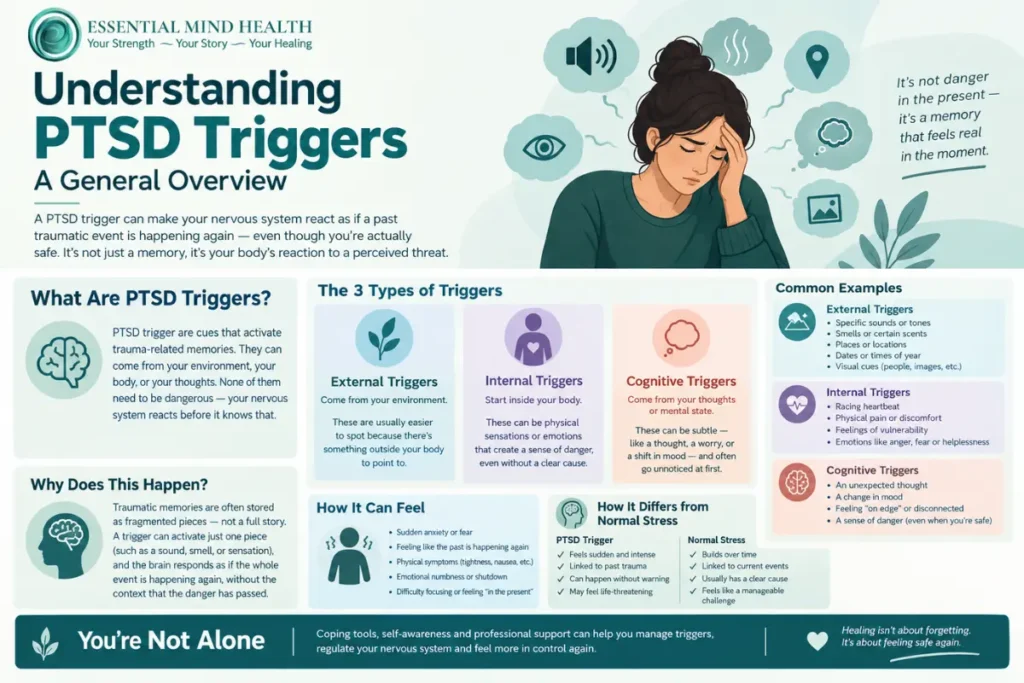
What Can Trigger a PTSD Response?
A trigger doesn’t have to make sense. Not to the people watching, and often not even to the person going through it. That’s one of the more disorienting parts of PTSD: an ordinary, safe moment can suddenly feel dangerous, with nothing in the room to explain why.
The explanation has to do with how traumatic memories get stored in the brain in the first place. Everyday memories usually sit along a clear timeline: a beginning, a middle, an end, something you could recount to a friend in order. Traumatic memories don’t work that way. They fragment. What survives tends to be sensation rather than a storyline, a sound, a smell, a certain kind of muscle tension, disconnected from the sequence of events that produced them.
Because of that fragmentation, a trigger can activate just one piece of the memory in isolation. The brain responds to that single fragment as though the whole event were unfolding again, minus the surrounding context that would otherwise make clear the danger has passed.
External Triggers: Sounds, Smells, Places and Other Environmental Cues
External triggers come from somewhere in the environment. Of the three categories, these are usually the easiest to eventually recognize, mostly because there’s something concrete outside the body to point to.
| Type | Examples |
|---|---|
| Sounds | A specific tone, volume, or type of noise connected to the traumatic event |
| Smells | A scent tied to the place or moment where the trauma occurred |
| Places | A location that resembles, or is directly connected to, where the event happened |
| Dates | Anniversaries or particular times of year associated with the trauma |
| Visual cues | Images, footage, or people who resemble someone involved in the event |
Not every external trigger is dramatic. Some are barely perceptible to anyone else in the room: a particular quality of afternoon light, an offhand tone of voice, an unfamiliar texture under the hand. To everyone nearby, the moment looks completely unremarkable. To the person experiencing it, the environment has just opened a direct line back to something dangerous.
Internal Triggers: When Physical Sensations Become Distressing
Internal triggers start inside the body instead of out in the environment. That makes them harder to trace back to a cause, since there’s no external object or event pointing to where the reaction came from.
Take a racing heartbeat during a workout. The exercise itself is completely safe. But the sensation alone, a pounding heart, quickened breathing, can be enough to set off a trauma response, regardless of what’s actually happening around the person in that moment. A feeling of vulnerability works the same way, whether that shows up during intimacy or just in an unfamiliar room. So do certain emotions on their own: anger, helplessness, the sense of being trapped, none of which need an actual outside cause to activate a response.
PTSD is hard to live with day to day partly because of this. It isn’t only the outside world that can set off a reaction. Sometimes the body reacts to its own internal state as if the state itself were the danger, which leaves very little room to feel safe anywhere, even inside your own skin.
Cognitive Triggers: Thoughts, Emotions and Changes in Perception
This category gets talked about less, but it’s just as real. In someone whose nervous system spent years learning to expect danger, certain mental processes can set off a trauma response. Having to make a fast decision is one example. Experiencing success, oddly enough, is another.
It helps to look at this from the nervous system’s point of view rather than take it at face value. If survival once depended on constant vigilance, on never fully letting your guard down, then relaxing, or succeeding, runs against a pattern built up over years. A moment of ease can register as unsafe simply because it’s unfamiliar territory for a system wired to stay alert.
Why Can a Trigger Cause Such a Strong Reaction?
Part of the answer comes down to which part of the brain responds first. A trigger can activate the amygdala, the brain’s fear center, directly, without first passing through the prefrontal cortex, the region responsible for rational thought and context. The whole sequence can happen within milliseconds, faster than a person can consciously register what’s going on.
Which is why telling yourself “I’m safe right now” doesn’t always work in the moment. The part of the brain responsible for reasoning isn’t the one steering the initial response. By the time conscious thought catches up, the body has usually already reacted.
What Does a PTSD Trigger Response Feel Like?
Trauma responses don’t always look like visible panic. They fall into two broad patterns that can look almost nothing alike.
| Response Pattern | What It Can Look Like |
|---|---|
| Hyperarousal | Racing heart rate, muscle tension, tunnel vision, fast and shallow breathing, a surge of stress hormones |
| Hypoarousal | Emotional numbness, a sense of disconnection from the moment, slowed movement, difficulty speaking or making decisions |
Both are legitimate trauma responses. Hypoarousal is the one that tends to go unnoticed, since it doesn’t match the fight-or-flight image most people associate with trauma. Someone in it might look calm. Even a little checked out. Meanwhile something very real is happening underneath.
PTSD Triggers vs Everyday Stress: How Are They Different?
The two get confused often enough that it’s worth pulling them apart. Everyone’s nervous system reacts to stress: a tight deadline, a hard conversation, nearly missing a flight. These reactions are normal, and they fade fairly quickly once the moment has passed.
A trauma response behaves differently. It’s often disproportionate to what’s actually happening, it can show up without warning, and it frequently doesn’t match the scale of whatever set it off, a minor, everyday sound can trigger a reaction that looks like someone facing real, immediate danger. That mismatch, between the size of the trigger and the size of the reaction, is one of the clearer signs that something beyond ordinary stress is going on.
Duration is different too. Ordinary stress fades once the stressful thing ends. A trauma response can linger for hours afterward, sometimes longer, leaving someone feeling shaken or foggy well after whatever set it off has passed.
Why Do Some People Develop Persistent Triggers?
A lot of people ask this, often about themselves. Two people can live through comparable events, and one ends up with persistent triggers while the other doesn’t. Neither outcome says anything about strength, or weakness, or how tough someone is.
Several factors seem to matter. How much support was available right after the event. Whether it was a single incident or something that happened repeatedly. A person’s history with earlier trauma, since prior experiences can lower the threshold for what the nervous system treats as dangerous. Genetics and baseline nervous system reactivity may play a role too, though that part of the research is still developing.
This isn’t a checklist for self-diagnosis. It’s meant to make one thing clear: developing triggers isn’t a character flaw, and not developing them isn’t some kind of toughness. It’s closer to how differently bodies process overwhelming experiences, shaped by circumstances mostly outside anyone’s control.
What Can Help During a PTSD Trigger?
A quick note before this part: these are general, widely used coping tools, not a replacement for professional treatment. They can help in the moment a trigger hits, but they won’t fix the underlying pattern by themselves.
Grounding is usually where people start. One version: name five things you can see, four you can feel, three you can hear, two you can smell, one you can taste. The idea is redirecting attention back to the present through the senses, since that’s typically what a trigger just pulled someone away from.
Bilateral stimulation is worth knowing too. Alternating taps or gentle pressure on each side of the body, sometimes called the butterfly hug, is thought to support a sense of regulation. The exact mechanism isn’t something to overstate, but a lot of people simply find it calming.
Cold sensory input can work fast. Holding something cold, or splashing cold water on the face, can help activate the body’s calming response almost immediately. There’s also pendulation: gently shifting attention between a part of the body that feels distressed and a part that feels calmer, a way of practicing movement between states instead of getting stuck in one.
Then there’s breath work, which sounds almost too simple to matter, but it genuinely helps a lot of people. Slow, extended exhales, longer than the inhale, are associated with signaling safety to the nervous system. It won’t undo a trigger response by itself. It can take enough of the edge off to make the other tools more usable.
These are tools for the moment, not a fix for the underlying pattern, and what works for one person can barely register for someone else. That variability is a large part of why working with a professional to figure out what actually helps matters more than following a generic list.
When Should You Seek Professional Support?
Recognizing your own triggers is a real, meaningful step. It isn’t treatment, though. A few signs it may be worth reaching out for professional support specifically: the triggers are becoming more frequent or more intense instead of settling with time, avoidance is starting to shrink daily life in a way that actually feels limiting, coping in the moment isn’t translating into feeling better over the hours or days that follow, or the responses are affecting work, relationships, or basic day-to-day functioning.
Needing that kind of support doesn’t mean something is wrong with a person. It means the nervous system needs support that’s genuinely hard to provide for yourself, especially given that a trigger response, almost by definition, bypasses the exact part of the brain most self-help strategies rely on.
How Essential Mind Health Approaches PTSD Care
PTSD care at Essential Mind Health takes a trauma-informed approach. Care doesn’t push anyone to describe traumatic details before they’re ready. Treatment typically combines trauma-focused therapy with medication support when appropriate, tailored to the specific symptoms and history involved, since PTSD can show up in acute, chronic, complex, delayed-onset, or dissociative presentations that don’t all look alike.
This piece works well as a companion to recovery from post-traumatic stress disorder, which goes deeper into what healing actually looks like and what treatment involves. PTSD symptoms overlap with anxiety often enough that it’s also worth reading why anxiety causes physical symptoms and are anxiety attacks dangerous, since a lot of what shows up during a trigger response overlaps with what those two pieces describe.
Medical Disclaimer: The information in this article is for educational purposes only and is not a substitute for professional medical advice, diagnosis, or treatment. Always consult a qualified healthcare professional regarding your individual health concerns.