
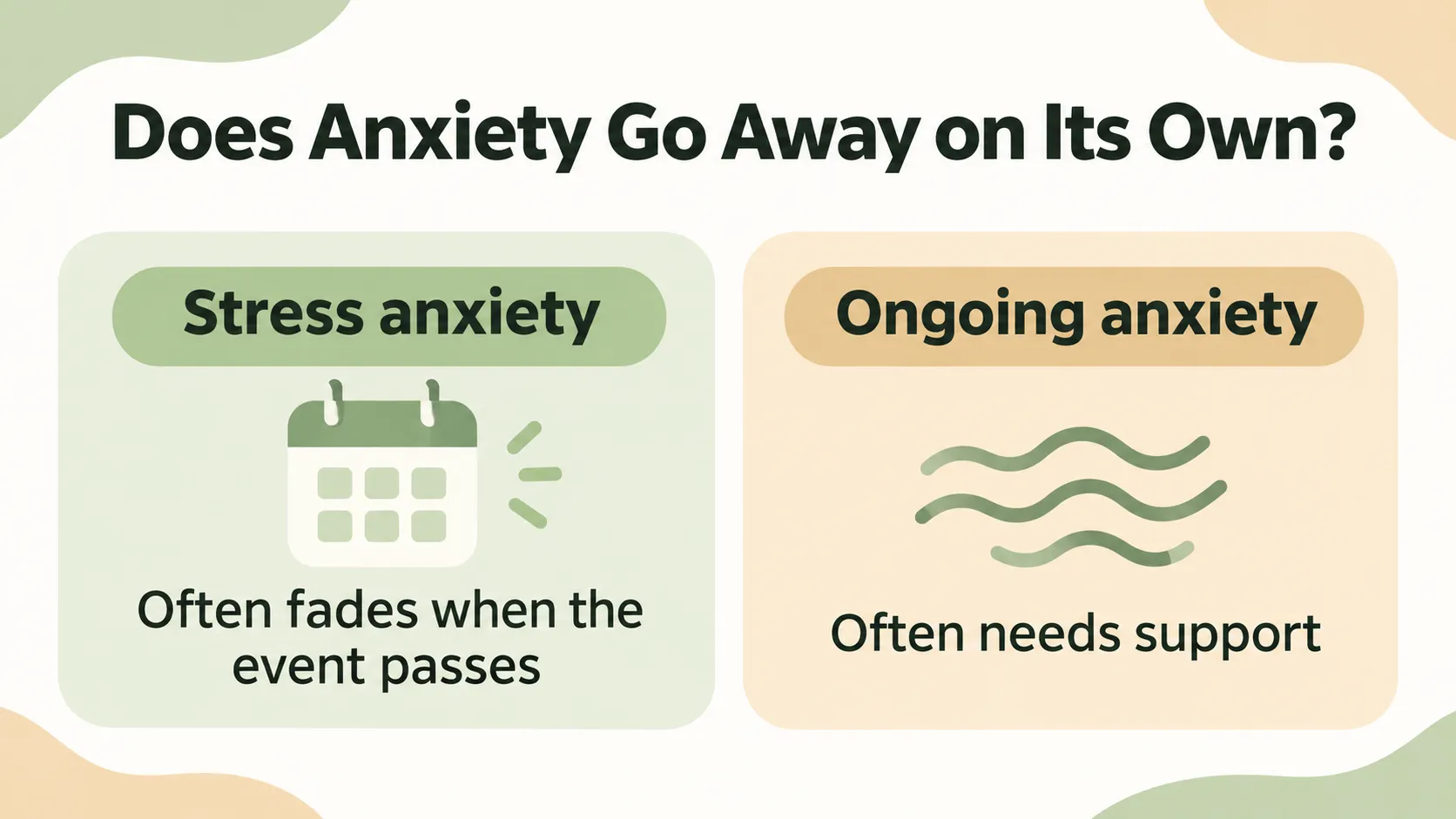
Sometimes it does. Anxiety that comes from a single stressful event, like an exam, a move or a hard week at work, often fades once the event is over. Anxiety that keeps going, shows up in many parts of life or gets in the way of your day usually does not go away on its own, and it can get worse over time. The earlier it gets treated, the easier it tends to be to treat.
So the real question is which kind you have. This guide shows you how to tell, how long anxiety can last, what you can try on your own, and the signs that it is time to talk to someone. It also answers the questions people type into search most often about anxiety fading, coming back and getting worse.
Does anxiety go away on its own?
It depends on what is driving it.
Anxiety linked to a specific stressor often passes. If you are nervous before a job interview, worried about a medical test or tense during a big move, the anxiety usually eases when the situation ends. That is normal anxiety, and almost everyone has it.
Anxiety that has no clear end point often stays. When worry keeps going without an obvious cause, jumps from one topic to the next, or follows you through every part of the day, it may be an anxiety disorder. Worries like that may not go away without help, and they can build over time. National health agencies describe it the same way: for people with an anxiety disorder, the anxiety does not go away, it shows up in many situations and it can get worse.
Plenty of people sit in the middle. They feel better for a few weeks, then something stressful happens and it all comes back. That pattern is common, and it is a good sign to look at the anxiety more closely instead of waiting for it to disappear.
How can you tell normal anxiety from an anxiety disorder?
The table shows the main differences. You do not need to match every line. Look at the overall pattern.
| Everyday anxiety | Anxiety disorder | |
|---|---|---|
| What starts it | A specific event or stress | Often no clear cause, or worry about many things |
| How long it lasts | Passes when the situation ends | Lingers for weeks or months |
| How strong it is | Matches the situation | Feels bigger than the situation calls for |
| How hard it is to control | You can usually calm down | Worry is hard to switch off |
| Effect on daily life | Little to none | Affects work, school, sleep or relationships |
| Behavior | You face the situation | You avoid it or keep asking for reassurance |
A useful test is to ask whether the anxiety is in proportion to what is going on, and whether it is getting in the way of your life. If the answer to the second question is yes, it deserves attention, even if the stress behind it seems small.
If you want a closer look at the line between ordinary worry and a diagnosable condition, generalized anxiety disorder vs worry goes into it in detail. And if you are not sure what anxiety feels like when it is more than stress, what anxiety feels like every day lists the common signs.
How long does anxiety last?
There is no set time. Anxiety can last minutes, days, months or years.
Here is how it usually breaks down:
- A panic attack usually lasts 5 to 20 minutes. It is frightening, but it is not dangerous.
- Stress anxiety often lasts as long as the stressful situation, and then it fades.
- Ongoing anxiety can last for months. For a diagnosis of generalized anxiety disorder, a doctor may look for anxiety that has been present a lot of the time for at least 6 months.
- Anxiety that is never treated can last for years, and it may change shape along the way.
If your anxiety has lasted weeks and you cannot point to a stressor that explains it, that is worth bringing up with a provider. You do not need to hit the 6 month mark first. The 6 months is a rule for making a diagnosis, not a waiting period for getting help.
For more about panic attacks and how they differ from anxiety, read panic attacks explained and whether anxiety attacks are dangerous.
Why does anxiety stick around?
A few things keep anxiety going. Knowing them helps explain why waiting does not always work.
The cause never goes away. Ongoing stress, such as money or work pressure, a family death or a long illness, can pile up. If the stress does not end, the anxiety often does not either.
Your background plays a part. Anxiety disorders are more likely if you have a family history of them, a history of trauma or abuse (especially in childhood), or another mental health condition such as depression. Some personality types are more prone to anxiety as well. You cannot control any of these, and none of them mean something is wrong with you.
Avoidance keeps it alive. Dodging what makes you anxious and asking others again and again for reassurance both feel like relief, and both are common features of anxiety disorders. Gradually facing the situation instead is one of the steps that reduces anxiety over time.
Alcohol, drugs and heavy caffeine feed it. Drug and alcohol use are linked with anxiety disorders, and caffeine can disrupt sleep, which is another thing anxiety leans on.
Physical causes can sit underneath. Some anxiety is linked to medical problems, such as thyroid problems or heart conditions, and to the side effects of certain medicines. That is one reason a checkup matters.
If you often feel tense without a clear reason, high functioning anxiety describes a common pattern where people keep performing well while feeling constantly wound up.
Can anxiety go away without treatment?
It can, mostly when it is mild and tied to a stressor that ends. For example, anxiety that started with a big deadline often eases after the deadline.
For anxiety that has no clear end, waiting is a gamble. It might ease for a while. It might also grow. Major health agencies say worries from an anxiety disorder may not go away on their own and may get worse, and that anxiety is easier to treat when it is caught early.
So a fair rule is this. Give yourself a short window, try the self help steps below, and watch whether things are improving. If you are no better after a few weeks, or if anxiety is affecting your sleep, work or relationships, get help sooner. There is no prize for putting it off.
What can you do on your own for anxiety?
Self help will not fix every case, but it helps and it costs nothing. These are the steps with the best support.
- Move your body. Regular exercise like walking, swimming or yoga helps. If you are just starting, begin gently and build up.
- Protect your sleep. Poor sleep makes anxiety louder, and anxiety makes sleep worse. Sleep and mental health explains how the two feed each other.
- Eat regular, healthy meals. A steady routine supports your body when it is under stress.
- Cut back on caffeine and alcohol. Both can set off or worsen anxiety, and caffeine can disrupt sleep.
- Practice breathing or relaxation. Slow breathing, meditation, yoga and similar methods can calm the body.
- Talk to someone you trust. Saying it out loud takes some of the weight off.
- Set small goals. Do one manageable thing at a time instead of tackling everything at once.
- Face things a little at a time. Instead of avoiding what scares you, take small steps toward it. This is one of the most useful habits, because it breaks the avoidance cycle.
- Avoid leaning on alcohol, cigarettes, gambling or drugs. They offer short relief and add to the problem over time.
If you have tried these for a few weeks and your anxiety has not improved, that is a sign you may need more than self help.
Can anxiety come back after it goes away?
Yes. Anxiety can ease for a while and then return, especially when a new stress arrives. Worries also tend to shift, moving from one concern to another over time, and some stretches feel lighter than others even while the underlying anxiety is still there.
That is why feeling better for a week or two does not always mean it is over. If your anxiety keeps returning, it helps to look at what is bringing it back, whether it is stress, sleep, avoidance or something else. A provider can help you sort that out and give you tools that work even when the next stressful period shows up.
Can anxiety get worse if you ignore it?
It can. Without help, anxiety may grow over time.
Long term anxiety is linked with several other problems:
- Depression
- Trouble sleeping
- Digestive problems and headaches
- Chronic pain
- Pulling away from friends and family
- Trouble at work or school
- Substance misuse
Anxiety can also show up in ways that do not look like worry. Anxiety that looks like irritability or anger is a good example, and many people miss it for years because they never think of it as anxiety.
Can anxiety turn into depression?
The two often show up together. Anxiety disorders commonly occur alongside depression, and long lasting anxiety is linked with a higher risk of developing it.
If you feel low as well as anxious, depression and anxiety together explains how they overlap, and treatment for depression and anxiety in adults covers what care looks like. Our depression therapy in Jupiter page lists what we treat.
What are the signs your anxiety needs treatment?
Getting help is a good idea if any of these sound like you:
- Your worry is hard to control.
- It gets in the way of work, school, sleep or relationships.
- You avoid places, people or tasks because of anxiety.
- Your body feels tense, or you have a racing heart, stomach trouble or headaches that keep coming back.
- You feel down, irritable or hopeless along with the anxiety.
- You use alcohol or drugs to cope.
- Self help has not worked after a few weeks.
- You are not sure whether your symptoms come from anxiety or a physical problem.
Anxiety disorders are among the most common mental health conditions. Up to one in three people may have one at some point in their lives. Needing help with it is ordinary, and it is not a sign of weakness.
If you are thinking about harming yourself, call or text 988, or call 911 if you are in immediate danger.
Can physical symptoms mean something else?
Yes, and it is worth knowing. Anxiety can cause a racing heart, shortness of breath, dizziness, headaches, chest tightness and stomach problems. Those same symptoms can also come from heart, thyroid or breathing problems, and from some medicines.
That is why a medical checkup is a smart first step if physical symptoms are new, strong or do not match your anxiety. If a doctor rules out a physical cause, you can feel more confident that anxiety is behind them. Why anxiety causes physical symptoms and physical symptoms of anxiety disorders explain what is going on in the body.
Which type of anxiety do you have?
Anxiety comes in several forms, and each one has its own pattern. The table gives a quick overview.
| Type | Main feature | Learn more |
|---|---|---|
| Generalized anxiety | Worry about many things that is hard to control | GAD vs everyday worry |
| Panic disorder | Repeated, sudden panic attacks and fear of more | Panic attacks explained |
| Social anxiety | Intense fear of being judged or embarrassed | Social anxiety vs shyness |
| Specific phobias | Strong fear of one object or situation | Anxiety disorders overview |
| Agoraphobia | Avoiding places where escape or help feels hard | Anxiety disorders overview |
Anxiety also overlaps with other conditions. Sometimes what looks like anxiety turns out to be ADHD mistaken for anxiety or depression, or it is tied to trauma and PTSD. A proper evaluation helps sort this out.
What does anxiety treatment look like?
Talk therapy is the main treatment. Cognitive behavioral therapy, or CBT, is the most effective form of therapy for anxiety. It teaches you skills for managing worry and for slowly returning to the things you have been avoiding.
It is usually short term. CBT is generally a short term treatment, not something you do for years. Even so, getting the right fit can take time. Finding the right approach sometimes takes some trial and error, and that is normal.
Healthy habits support it. Exercise, sleep, less caffeine and relaxation methods all help, and they work well alongside therapy.
For more on what therapy looks like, how therapy works and the benefits of cognitive behavioral therapy walk through what to expect. If you are worn down from carrying anxiety for a long time, emotional exhaustion describes where that can lead. And if you are curious about how care works when you cannot get to an office, what online mental health care is like answers the common questions.