
You feel sad at night because the things that keep your mind busy during the day are gone, your body is tired, and your thoughts finally get room to be loud. For most people this is a normal pattern that shows up now and then. For others, sadness that grows after dark is one sign of depression.
“Nighttime depression” is a popular phrase, but it is not an official diagnosis. It is a plain way to describe low mood that appears or gets worse in the evening. Many things can cause it: stress you pushed aside all day, poor sleep, bright screens, alcohol, loneliness, or a body clock that is out of rhythm.
This guide explains each cause in simple words. It also covers what you can do tonight, what to change during the day, and when it is time to talk to a professional.
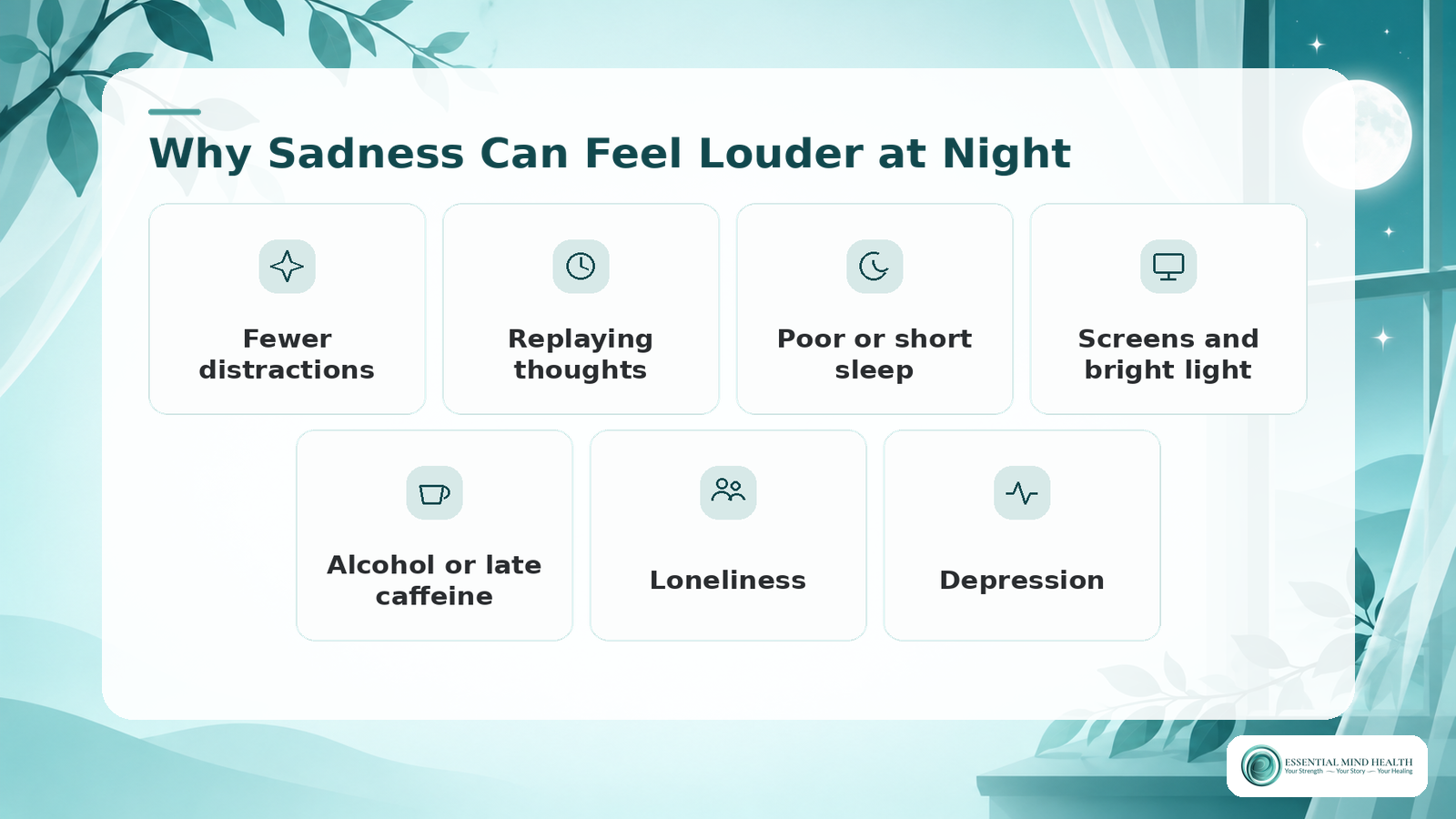
What are the most common reasons for feeling sad at night?
Here is a quick look at the main causes. Each one is explained in more detail below.
| Reason | What it can feel like | What often helps |
|---|---|---|
| Fewer distractions | The day was fine, then sadness shows up as soon as it gets quiet | Plan something calm and engaging for the evening |
| Replaying thoughts | Old mistakes or future worries loop in bed | Write the thoughts down and set them aside |
| Poor or short sleep | Everything feels heavier when you are tired | A steady sleep schedule |
| Screens and bright light | Scrolling leaves you wired and down | Dim lights and put the phone away earlier |
| Alcohol or late caffeine | Sleep is broken and mood drops the next day | Cut back, and skip caffeine late in the day |
| Loneliness | The house is quiet and no one is around | Plan contact with people earlier in the day |
| Depression | Low mood is there most days, not only at night | Talk to a mental health professional |
Is it normal to feel sad at night?
Yes, it is common. A lot of people feel their mood dip when the day ends. The body slows down, the lights go low, and the mind has nothing left to do except think.
Your body also runs on a clock. This body clock helps decide when you feel awake, when you feel hungry, and when you feel sleepy. It also helps control body temperature and hormone levels. Because mood is tied to sleep and energy, it can dip when the clock tells your body it is time to wind down.
One bad evening is not a sign that something is wrong. Pay attention when it happens night after night, or when the sadness follows you into the next day.
Is nighttime depression a real thing?
Nighttime depression is not a medical diagnosis. Doctors do not use it as a formal label. People use it to describe depression symptoms that get worse, or only seem to show up, late in the day.
Here is the part that surprises many people. Depression is not usually a condition that happens only after dark. If you have clinical depression, it is likely touching other parts of your day too, even if the evening is the hardest part. You may not notice it in the daytime because work, school, or other people keep you moving.
Doctors also see a pattern called diurnal mood variation, which means mood changes in a regular way through the day. The classic version is feeling worst in the early morning and better as the day goes on. Some people have the opposite pattern, with mood dropping in the afternoon or evening. Different patterns can even show up within one episode, so there is no single “correct” version.
If you want to understand depression itself first, our post on hidden depression symptoms is a good place to start.
Why does sadness hit harder when the day ends?
There are three simple reasons.
- Your mind finally has room. During the day, work, school, chores, and people all take up attention. At night, there are far fewer things to focus on. Feelings you pushed aside earlier get a chance to come forward. Worries that you did not have time for during the day tend to show up when you lie down.
- You are tired. A tired brain may have a harder time handling feelings. Small problems feel bigger, and it is harder to think clearly or see another side of things. Late at night, a thought that would be manageable at noon can feel heavy.
- Your energy is low. Low energy is a common sign of depression. If you often feel drained, you may also want to read about why depression makes you tired. Many people notice that drain most in the evening.
A helpful thing to know is that mood often brightens by morning. This does not mean your feelings are not real. It means the heavy thoughts you have at 1 a.m. are often a product of tiredness, so it helps not to treat them as facts.
Why do my thoughts get louder when I lie down at night?
When you lie in bed in the dark, your brain has nothing else to work on. This is when many people start replaying the day, going over a mistake, or imagining what could go wrong tomorrow.
This habit has a name: rumination. It means thinking about the same upsetting thing again and again without getting any closer to a solution. It feels like problem solving, but it mostly spins in circles. The brain is built to solve problems, so it keeps working on anything that feels unfinished. The trouble is that some things have no clear answer, and thinking about them for hours does not produce one.
Rumination is not a disorder on its own, but it is closely linked with depression, anxiety, and trouble sleeping. It can also make a low mood last longer. When you ruminate at night, you lose sleep, and when you lose sleep, your mood is lower the next day, which gives you more to ruminate about.
If your nights are mostly about racing worry instead of sadness, read about what anxiety feels like every day and how depression and anxiety overlap. It is common to have both at once.
How can you tell nighttime sadness from nighttime anxiety?
They can feel alike, but they usually have a different feel.
- Sadness tends to feel heavy and low. You may feel empty, tearful, hopeless, or flat.
- Anxiety tends to feel tense and restless. Your heart may race, and your thoughts jump from one worry to the next.
You can have both. Many people with depression also have anxiety, and the two often show up together at night.
Can poor sleep make evening sadness worse?
Yes, and it works in both directions. Low mood makes sleep harder, and poor sleep makes low mood worse.
Trouble sleeping is one of the most common signs of depression. About 40 percent of people with insomnia also have clinical depression, and many people with depression have stretches of insomnia. Waking up very early and not being able to fall back asleep can be a sign of depression too.
You do not need depression for sleep to affect your mood. Staying up too late, waking too early, or sleeping badly can lower mood in almost anyone. Most people feel worse after sleep is disrupted.
If you want the full story on how sleep and mental health affect each other, our post on sleep and mental health covers it. If your sleep problems are the main issue, you can also read about how insomnia is treated. Our insomnia therapy in Jupiter page explains the care available when poor sleep and low mood show up together.
Do screens, bright light, alcohol, and caffeine make nighttime sadness worse?
They can. These are the habits most people can change fastest, so they are worth looking at.
- Screens and bright light. Scrolling in bed keeps your brain active and can push bedtime later. Some research, much of it in animals, suggests that bright light at night, especially blue and white light, may keep you awake and may worsen low mood. Health sources suggest putting devices away anywhere from 30 minutes to a couple of hours before bed. Pick a time you can really keep.
- Alcohol. A drink can feel like it takes the edge off at night, but alcohol is a depressant. It can worsen low mood and it breaks up sleep, including the deep sleep your brain needs. It can leave you feeling worse the next day.
- Caffeine and late meals. Caffeine late in the day can keep you from falling asleep. Heavy meals right before bed can also get in the way of rest. Try to keep caffeine to the morning and early afternoon, and skip big meals close to bedtime.
- Napping. A short nap of 10 to 20 minutes may help in the day. Longer naps can make it harder to fall asleep at night.
Can loneliness and a quiet house make you feel sadder at night?
They often do. At night, the people who fill your day are usually not around. A quiet house can make you feel alone even if you have people who care about you.
Pulling away from friends and family is also a common sign of depression. It becomes a loop. You feel low, so you see fewer people, and then the evenings feel even emptier.
Since evenings are hardest, it helps to put contact earlier in the day. A walk with a friend in the afternoon, a phone call during dinner, or a short chat with a neighbor can all make the evening feel less empty. If you are not sure how to talk about it, our guide on how to help someone with depression can also help you explain what you are going through to the people close to you.
Does the time of year affect feeling sad in the evening?
It can. In fall and winter, the days get shorter and the sun sets earlier. Less daylight can throw off the body clock and affect mood in some people.
Seasonal affective disorder, or SAD, is a type of depression that returns at about the same time each year. Winter pattern is the most common type. It usually begins in late fall or early winter and eases in spring. Signs can include low energy, oversleeping, craving carbs, and pulling away from others.
If your evening sadness is stronger in the darker months, this may be part of the reason. Our post on seasonal depression vs. winter blues explains how to tell them apart.
When is sadness at night a sign of depression?
Sadness at night is more likely to be depression when it is part of a bigger pattern. Look at the rest of your day and your week, not only the late hours.
Common signs of depression include:
- Feeling sad, empty, or hopeless
- Losing interest in things you used to enjoy
- Feeling tired or low on energy
- Trouble sleeping, waking very early, or sleeping too much
- Changes in appetite or weight
- Trouble concentrating or making decisions
- Feeling guilty or worthless
- Feeling irritable or restless
- Aches and pains with no clear cause
- Pulling away from friends and family
- Thoughts of death or suicide
You do not need every one of these. Depression is usually considered when low mood or loss of interest lasts most of the day, nearly every day, for at least two weeks.
Depression can also look different from the sadness most people picture. For some, it shows up as irritability or numbness. You can read more in our post on why depression sometimes shows up as irritability or numbness instead of sadness. Physical signs are common as well, and our guide to physical symptoms of depression lists them.
How long should you wait before getting help for low mood?
A good rule is two weeks. If you have felt down for most of the day, nearly every day, for more than two weeks, it is time to talk to a professional. You can also get help sooner if your sleep is badly off or if the sadness gets in the way of work, school, or home life. If you are curious how long a low period can last, read how long a depressive episode lasts.
If your sadness only shows up at night and clears up easily, it may be related to stress or sleep habits. It is still fine to talk to someone about it. You do not have to wait until it gets worse.
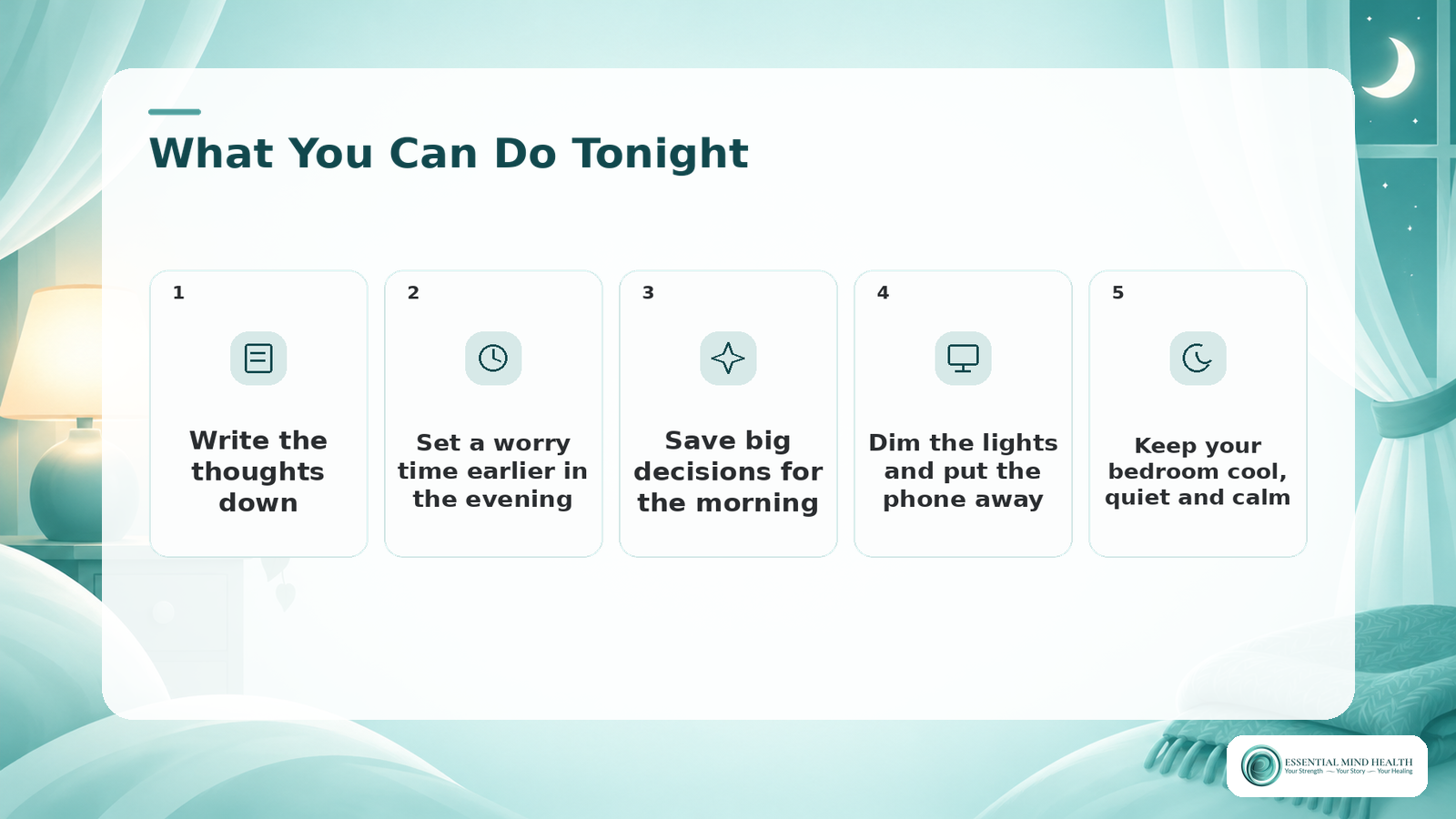
What can you do tonight when sadness hits at bedtime?
You cannot make a feeling disappear on command, but you can lower its volume. These steps are simple and most are free.
- Write the thoughts down. Keep a pen and paper by your bed. When a worry shows up, write it down, then put the paper away. Look at it again in the daytime, when there is usually more you can do about it.
- Set a worry time. Pick a short window earlier in the evening, like 10 minutes at 6 p.m., to think about what is bothering you. When the worry comes up at night, tell yourself it already has a time. Many people find the urge fades before the set time arrives.
- Do not make big decisions at night. Thoughts can feel bigger and more final when you are tired. Save life choices, hard messages, and money decisions for the morning, and focus on small, calm things while you are awake.
- Change what your mind and hands are doing. It is hard to ruminate while you are busy. Cleaning out a drawer, drawing, doing a puzzle, or making tea can pull your attention away from the loop. Choose something gentle in the evening so you are not wired at bedtime.
- Let the thought pass. You can notice a thought without arguing with it. Try saying to yourself, “That is a sad thought, and it will pass.” You do not have to solve it, chase it, or believe it.
- Dim the lights and put the phone away. Lower the lights in your home in the hour before bed. Charge your phone away from the bed if you can.
- Keep your bedroom calm. Keep it cool, quiet, and relaxing. Leave work and stressful tasks out of it.
- Reach out to someone. A short text or call to someone you trust can take the edge off. You do not have to explain everything.
 What can you change during the day to make nights easier?
Evening mood is often built during the day. These habits support better sleep and a steadier mood.
- Get daylight. Time outside, especially in the morning, helps set your body clock and supports the sleep hormone your body releases at night.
- Move your body. Regular exercise is linked to better sleep and lower depression symptoms. If you have not been active, start with a gentle 20 minute walk each day. Earlier in the day is better, because hard workouts late at night can keep you awake.
- Keep the same sleep schedule. Go to bed and get up at about the same time each day, even on weekends. Adults aged 18 to 60 need at least seven hours of sleep.
- Get up at your usual time. A steady wake up time helps protect your sleep.
- Eat regular meals. Cooking and eating at regular times keeps the day steady.
- Stay in touch. Time with friends and family can lift mood and gives you someone to turn to.
- Cut back on alcohol. It does not solve problems, and it can make low mood worse.
- Skip caffeine in the afternoon and evening.
Small changes add up. You do not need to do everything at once. Pick one or two and keep them for a couple of weeks before you add more.
What kind of treatment helps with depression that gets worse at night?
If sadness at night is part of depression, treatment does not focus on the night alone. It looks at your mood, your sleep, your thoughts, and your daily life together.
Talk therapy. Cognitive behavioral therapy, or CBT, helps you notice automatic thoughts that are inaccurate or harmful, question them, and change the patterns that keep you stuck. This fits nighttime sadness well, because so much of it comes from thoughts that spin in bed. Our posts on the benefits of cognitive behavioral therapy and how therapy works explain what sessions are like. Interpersonal therapy is another option our clinic offers.
Help with sleep. When insomnia is part of the picture, a form of CBT built for sleep, called CBT for insomnia, is a treatment for long term sleep problems. Looking at sleep and mood together is a common way to approach it.
A full evaluation. A provider can ask about your symptoms, how long they have lasted, and your history. They can also check for other causes that may be affecting your mood or sleep. You can read about depression treatment options for adults to see what care can look like.
Treatment takes time, and progress is not always a straight line. If you want to know what to expect, our posts on depression treatment response and whether depression goes away on its own go into more detail. It is also worth knowing that low mood can return after you feel better, which is why we wrote about depression relapse warning signs.
When should you get help right away for nighttime sadness?
Some nighttime feelings need quick attention. Do not wait it out if you notice any of these:
- Thoughts of suicide or of harming yourself
- Strong fear or feeling that people are against you
- Feeling unusually irritable or acting on sudden impulses
If you are thinking about hurting yourself, call or text 988 in the U.S. to reach the 988 Suicide and Crisis Lifeline. It is open 24 hours a day, seven days a week. If you are in immediate danger, call 911. You can also reach out to someone you trust and ask them to stay with you.
Depression Care in Jupiter and Across Palm Beach County
Essential Mind Health treats depression in adults 18 and older. Our depression therapy in Jupiter page covers major depression, persistent depression, seasonal depression, and depression that comes with anxiety or poor sleep. A first visit covers your symptoms, history, and goals, and a plan is built from there with follow ups to adjust it. Providers also check for medical causes that could affect mood.
You can be seen in person at our Jupiter office or through secure video visits from home. If you live nearby, you can learn more about depression treatment in North Palm Beach, online depression treatment in Palm Beach Gardens, or online depression treatment in West Palm Beach. If poor sleep is part of what you are dealing with, see our pages on insomnia treatment in North Palm Beach, online insomnia treatment in Palm Beach Gardens, and online insomnia treatment in West Palm Beach.
Many people with low mood also have worry or anxiety. Our anxiety therapy in Jupiter page covers that side of care. For a wider look at care in your area, see our hubs for mental health care in Palm Beach Gardens, mental health care in West Palm Beach, and mental health care in North Palm Beach. If you are new to video care, our guide on what online mental health care is like walks through it.
Your care is led by Jennifer Caschetta, PMHNP-BC, a board certified psychiatric mental health nurse practitioner. You can read more on the meet our provider page. To book a visit, use the contact page or call (561) 954-5123.