

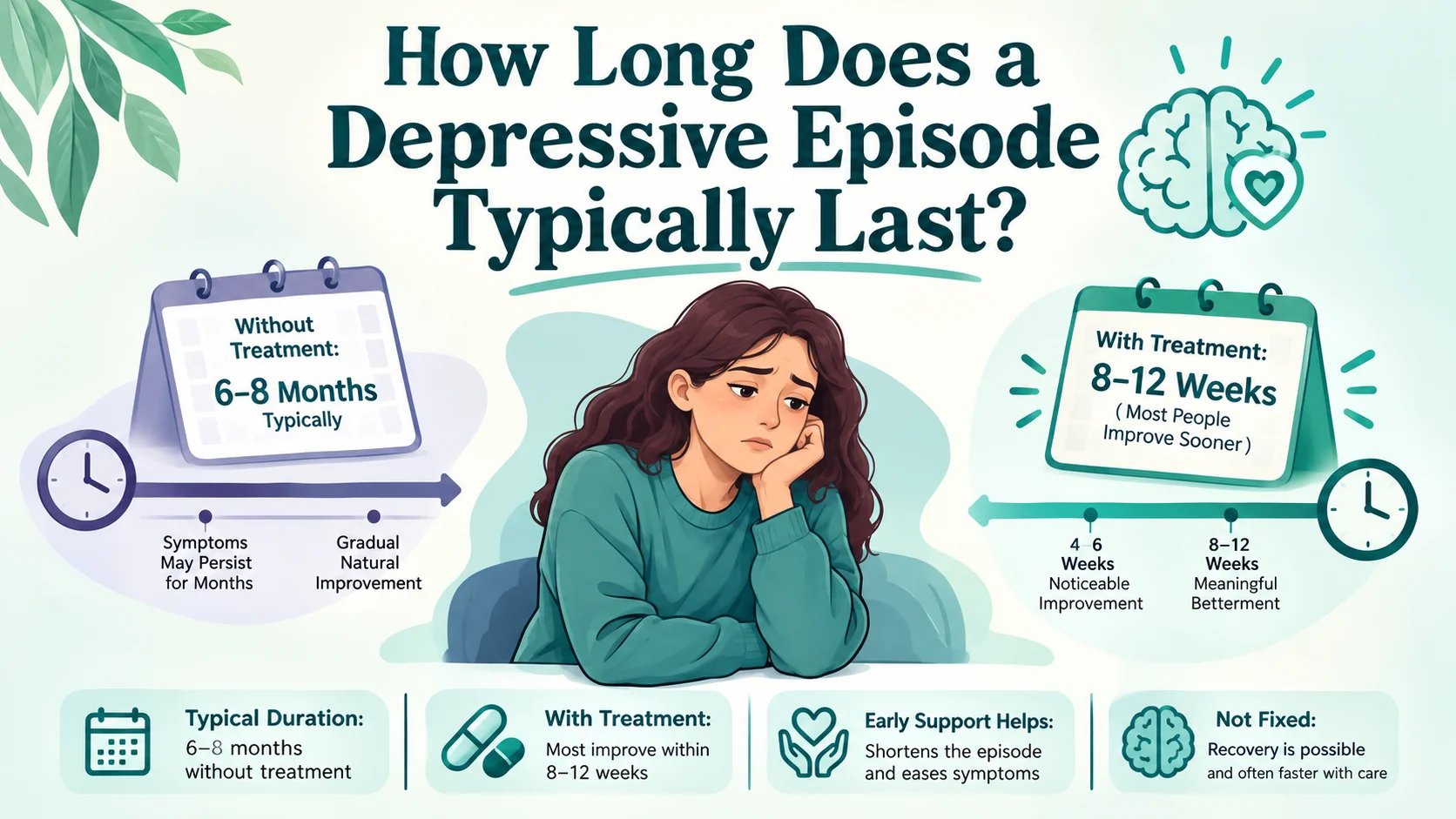
A depressive episode typically lasts six to eight months when left untreated. With professional treatment, medication, therapy, or a combination of both, most people begin to feel meaningfully better within eight to twelve weeks, and many experience significant improvement sooner than that. The timeline is not fixed, and several factors influence how long an episode lasts: whether it is a first episode or a recurrence, the severity of symptoms, the presence of other conditions, and how quickly treatment is started. Understanding the typical trajectory helps make sense of what you are going through and why getting support sooner rather than later makes a real difference to how long the episode lasts.
What Counts as a Depressive Episode
A depressive episode is a period during which depression symptoms are present most of the day, nearly every day, for at least two weeks. That two-week threshold is the clinical minimum for a diagnosis of major depressive disorder but in reality, most people who seek help have been experiencing symptoms for considerably longer before they reach out.
The two weeks is not what most people actually live through. The typical pattern is a gradual worsening over weeks or months before the episode is at its most intense, followed by a slow improvement with or without treatment. Understanding that the episode has a trajectory that it is not an indefinitely fixed state is something many people in the depths of depression do not have access to, and it matters.
How Long an Untreated Episode Typically Lasts
Research consistently finds that untreated depressive episodes last, on average, six to eight months. Some resolve earlier four to five months and some persist considerably longer, particularly if the person is under ongoing stress, has significant life disruptions, or has other health conditions that complicate recovery.
A meaningful proportion of people experience episodes lasting a year or more without treatment. This is not because depression is untreatable, it is because the brain’s emotional regulation systems take time to recalibrate on their own, and without intervention that actively addresses the maintaining factors, recovery is slower and less complete.
There is also a specific clinical category worth knowing: Persistent Depressive Disorder (PDD), sometimes called dysthymia. This is defined by depressive symptoms that have been present for two or more years lower in intensity than a major depressive episode but chronic. People with PDD sometimes do not recognise what they are experiencing as depression precisely because it has been present so long it feels like personality rather than a condition. If you have felt persistently low, flat, or joyless for years rather than months, that is worth discussing with a provider not just the months since it got noticeably worse.
How Treatment Changes the Timeline
This is the most practically important part of the picture: treatment does not just reduce the severity of a depressive episode it significantly shortens how long it lasts.
Most people who begin appropriate treatment whether medication, psychotherapy, or both start to notice meaningful improvement within four to six weeks. For many, the most significant improvement occurs between weeks eight and twelve. This does not mean symptoms disappear entirely at the twelve-week mark, but the trajectory is typically clear: things are meaningfully better than they were, functioning is returning, and the most acute phase of the episode is resolving.
Antidepressant medications typically take two to four weeks to begin having a noticeable effect, and the full therapeutic benefit often develops over six to eight weeks. This lag is one of the most frustrating aspects of depression treatment starting medication requires committing to something that does not provide immediate relief. Understanding that the lag is expected, not a sign that the medication is not working, helps people stay with a treatment plan long enough to see the benefit.
Psychotherapy, particularly cognitive behavioural therapy (CBT) produces improvements on a slightly different timeline, with meaningful change typically emerging over eight to sixteen sessions. For some people, therapy alone is sufficient. For others, particularly those with moderate to severe depression, a combination of medication and therapy produces faster and more durable improvement than either alone.
The important point is that treatment compresses a six-to-eight-month untreated trajectory into something considerably shorter for most people and reduces the risk of the episode returning.
What Affects How Long Your Episode Lasts
There is no single formula because depressive episodes vary significantly between people and between episodes in the same person. The factors that most consistently influence duration:
How quickly treatment begins. The sooner an episode is recognised and treated, the shorter it tends to be. This is one of the most robust findings in depression research and one of the clearest arguments for seeking help when symptoms emerge rather than waiting to see if they resolve on their own. The relationship between delay and duration is well established; longer waits to treatment are associated with longer episodes and slower recovery. Our post on whether depression goes away on its own covers this question in more detail.
Whether it is a first episode or a recurrence. First episodes are often the longest. This is partly because they are most likely to go unrecognised, delaying treatment, and partly because the brain’s patterns around depression have not yet been established. Subsequent episodes often resolve faster in part because the person recognises symptoms earlier and seeks treatment sooner, and in part because an existing treatment approach can be restarted rather than developed from scratch.
Severity at the episode’s peak. Severe episodes involving significant functional impairment, inability to work, or difficulty with basic daily tasks typically take longer to fully resolve than mild to moderate episodes, even with treatment. This is not discouraging; it is simply realistic about the relationship between severity and recovery time.
The presence of other conditions. Depression frequently co-occurs with anxiety, something we cover in depth in our post on whether anxiety and depression are related. When both are present, treatment needs to address both, which can affect the timeline. Similarly, untreated health conditions, substance use, significant ongoing stress, and sleep disruption all slow recovery from a depressive episode.
Life circumstances and support. This is harder to quantify but consistently significant. People with stable housing, supportive relationships, reduced acute stressors, and access to consistent care tend to recover faster than those navigating multiple simultaneous adversities. This does not mean recovery is impossible in difficult circumstances, it means that addressing contributing stressors alongside the depression itself, where possible, supports a faster trajectory.
Whether the episode has a seasonal pattern. Seasonal Affective Disorder (SAD) is a subtype of depression with episodes that follow a predictable seasonal pattern most commonly beginning in the autumn, peaking in winter, and resolving in spring. For people with SAD, the episode duration is partly determined by the season, though treatment still compresses and reduces symptoms within that window.
The Shape of Recovery
Recovery from a depressive episode is rarely a straight line, and understanding the actual shape of improvement helps people stay with treatment when the path feels non-linear.
Most people do not go from depressed to fully recovered in a smooth upward trajectory. More commonly, there are days or weeks of improvement followed by a period where things feel harder again not as hard as the worst of the episode, but noticeably more difficult than the recent improved days. This pattern can feel like relapse, but in most cases it is a normal part of recovery rather than treatment failure.
The overall direction matters more than any individual day or week. If the average of the last month is better than the average of the month before, recovery is progressing even if this week has been harder than last week.
A few specific things often return before others. Sleep tends to improve before mood does. Appetite and energy often return before motivation or the capacity to enjoy things (anhedonia). Some people describe feeling functional again, able to work, manage responsibilities, maintain basic routines while still not feeling fully like themselves. This intermediate stage is real and worth naming: it is not the destination, but it is not the beginning either.
How Long Before You Feel Like Yourself Again
This is the question people most want to ask but do not always know how to frame. The clinical answer to “how long does depression last” is six to eight months untreated, shorter with treatment but what most people mean is: when will I feel like myself again?
That question has a slightly different answer. The most acute symptoms, the inability to function, the heaviest emotional weight, the worst of the fatigue typically improve within the first few months of treatment. The fuller return of a sense of engagement with life, genuine enjoyment of things, and the feeling of being connected to your own experience can take longer sometimes six months to a year, from the start of treatment, even in people who have responded well.
This is not a reason for discouragement. It is a reason for realistic expectations about recovery and for staying with treatment and support even after the most acute phase has passed, rather than stopping medication or therapy the moment functioning returns.
The relationship between depression and fatigue is one of the symptoms that often persists into recovery longer than others if that is part of your experience, our post on why depression makes you tired explains what is happening and what helps.
Can One Episode Predict Future Episodes?
This is worth addressing because it is something many people wonder but may not ask directly.
Having one depressive episode does increase the statistical likelihood of experiencing another. Research suggests that after a first episode, approximately 50% of people experience a recurrence at some point. After two episodes, that figure rises. After three or more, maintenance treatment continuing medication or therapy even when feeling well is often recommended to reduce recurrence risk.
This is not a certainty and it is not a sentence. Many people experience a single depressive episode in their lifetime and do not have a recurrence. For those who do experience recurrences, the pattern is often that subsequent episodes are recognised earlier, treated faster, and resolved more quickly than the first. The experience of having navigated one episode knowing what the early warning signs feel like, knowing what helped, having an existing relationship with a provider is itself protective.
When the Episode Is Taking Longer Than Expected
If you have been in treatment for three months or more and are not experiencing meaningful improvement, that is important information to bring back to your provider, not a reason to conclude that treatment cannot help.
Several things can limit treatment response:
- The medication dose may need adjustment
- A different medication or medication combination may suit you better
- A contributing factor an undertreated condition, sleep disruption, a life stressor may be maintaining the episode and needs to be addressed alongside the depression itself
- The therapeutic approach may not be the best fit, and a different modality or provider may produce better results
Treatment-resistant depression is a real clinical entity, but most people who feel their treatment is not working are not experiencing true treatment resistance they are experiencing a treatment plan that needs adjustment. The key is maintaining the conversation with your provider rather than disengaging from care.
What to Do if You Recognise Yourself in This?
If you have been experiencing depressive symptoms and have not yet sought help or have been waiting to see if things improve on their own the evidence is clear that early intervention shortens episodes and improves outcomes.
If you have been in treatment and are wondering whether your timeline is typical, or whether something needs to be adjusted in your care, that is exactly the conversation to have with your provider at your next appointment.
If you are in Jupiter, FL or the surrounding area and want to talk with someone about what you are experiencing, our Depression service page explains the approaches we use and what an initial appointment involves.