

Depression changes more than mood. Sleep, appetite, energy, pain, digestion, sex drive, and for some people even the brain and heart, can all be affected. Most people notice the physical part first. The link to depression, if they ever make it, usually comes later.
What Physical Symptoms Can Depression Cause?
A fairly consistent set of physical symptoms shows up with depression. The ones reported most often:
- Fatigue that doesn’t improve with rest
- Sleep changes insomnia or sleeping more than usual
- Appetite or weight changes
- Headaches, back pain, or general aches
- Digestive issues like nausea or altered bowel habits
- Reduced interest in sex
- Slowed or restless movement
- Trouble concentrating
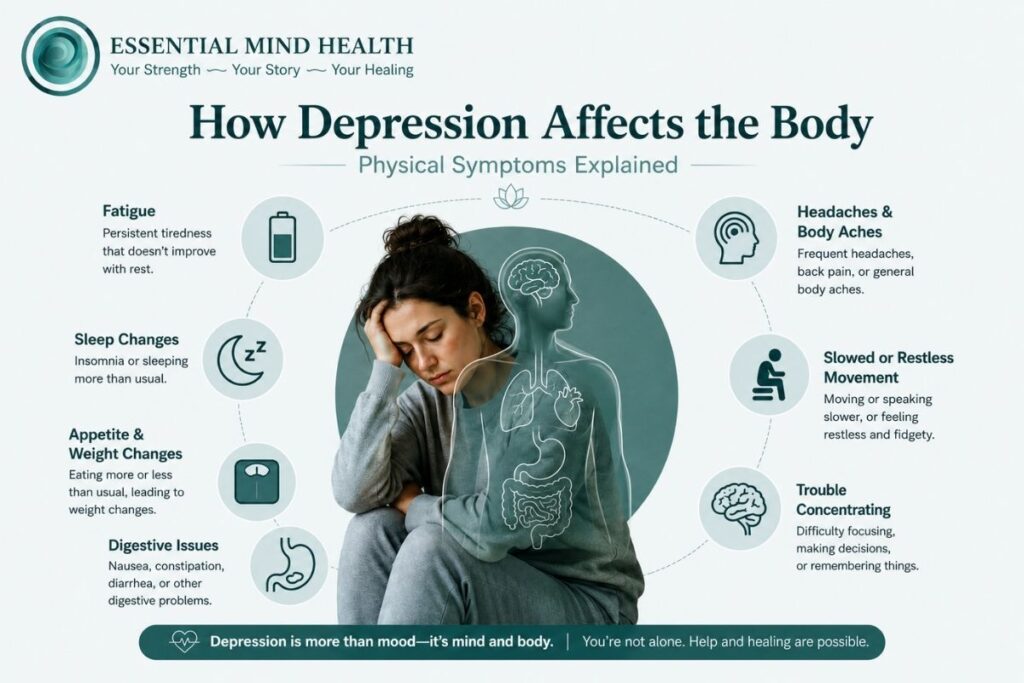
Nobody gets the full list, and it looks different from one person to the next. Movement is a good example of this. Some people get restless, fidgety, unable to sit still. Others go the opposite way talking slower, moving slower, everything taking a bit longer than usual. Clinicians call this psychomotor agitation or retardation. Unlike fatigue, which is mostly felt privately, this is something other people can actually notice from the outside.
For some people the physical symptoms are basically the whole picture, and sadness barely enters into it. Men often fall into this group describing fatigue, irritability, or aches before they’d ever describe feeling sad. Older adults tend the same way, showing up with pain, poor sleep, or a foggy head rather than an obvious low mood. And because most people bring these complaints to a family doctor instead of a therapist, a fifteen-minute appointment about back pain rarely leaves room to ask about mood at all. That combination is a big reason depression’s physical side goes unrecognized for months in some people.
Clinicians use the DSM-5-TR to diagnose major depressive disorder, and several of its nine listed symptoms aren’t emotional at all changes in sleep, appetite or weight, energy, and psychomotor activity are on that list. A diagnosis needs five or more of the nine, present for two weeks. Depression was never defined as a mood problem alone; the body was always part of the criteria.
Energy and Sleep
Fatigue is one of the most common complaints in depression, and it doesn’t act like ordinary tiredness. People describe waking up drained after a full night’s sleep, or finishing a lazy weekend and still feeling wiped out. A few things seem to feed into it: poor sleep, changes in the brain chemistry that governs alertness, and the wear of stress hormones running high for too long. Nobody has fully mapped out how these pieces fit together.
Sleep goes both ways with depression. Some people can’t fall asleep or stay asleep. Others sleep for hours and still wake up tired. Poor sleep makes depression worse. Depression makes sleep harder to get right. Round and round it goes.
This kind of fatigue is heavier than people expect going in. Someone can hold down a job just fine and still have nothing left over for a workout, dinner with friends, or even running errands. That gap functioning at work but running on empty everywhere else is exactly why fatigue counts as a real clinical symptom here, not an excuse.
Can Depression Cause Physical Pain?
It can. Headaches, back pain, muscle aches, and other discomfort that doesn’t trace back to any obvious cause turn up often in people with depression.
Mayo Clinic ties this to shared brain pathways serotonin and norepinephrine show up in both pain regulation and mood regulation. That overlap is why some antidepressants get prescribed for chronic pain even in patients who aren’t depressed at all. The relationship runs in both directions, too: chronic pain can trigger depression, and depression can turn up the volume on pain someone already has. Pain that won’t go away and doesn’t have a clear source is worth mentioning to a doctor rather than shrugging off.
Appetite, Weight, and Digestion
Appetite swings either direction with depression. Some people lose interest in eating and drop weight. Others eat more and put weight on. The DSM-5-TR treats a weight change of around 5% of body weight or more in a month as a clinically relevant sign not proof on its own, just one piece a clinician factors in.
Digestive symptoms come up a lot too: nausea, constipation, bowel habits that suddenly look different. The leading explanation is ongoing back-and-forth between gut and brain the gut-brain axis, involving the vagus nerve, hormones, and gut bacteria though exactly how it all works is still being pieced together. You’ll sometimes see the claim that most of the body’s serotonin is made in the gut, not the brain. That’s accurate. What it doesn’t mean is that gut serotonin travels up and drives mood; it stays local, doing its own job in digestion. The gut-brain connection to depression is real and gets studied seriously, but it’s a lot messier than a single fact about where serotonin is manufactured.
Depression also turns up more in people with conditions like irritable bowel syndrome. Which way the arrow points is still unsettled gut problems triggering depression, depression triggering gut problems, or both feeding each other in a loop. The vagus nerve is one likely piece of that puzzle. It connects the brainstem to the gut and carries signals in both directions, and it’s thought to help explain how stress and mood spill over into digestion.
How Depression Can Affect the Brain
Depression comes with measurable changes in brain activity, though the science has moved well beyond the old “chemical imbalance” explanation. Serotonin, dopamine, and norepinephrine all play a role. But low serotonin on its own isn’t treated as the cause anymore; current research points to broader changes across brain circuits and stress-response systems, not one chemical dipping too low.
Consider the hypothalamic-pituitary-adrenal (HPA) axis, which governs cortisol release. In a healthy stress response, cortisol rises and then drops back down. In some people with depression, it stays elevated longer than it should. Not everyone with depression shows this. And whether elevated cortisol causes depression or the other way around that’s still an open question.
Brain scans add another piece. The ENIGMA Major Depressive Disorder Working Group pooled scan data from thousands of participants across many research sites, and found that people with recurrent depression had, on average, a slightly smaller hippocampus than people without depression. This is strictly a group-level finding no individual scan could show it, and it wasn’t present at all in people going through a first depressive episode. It doesn’t mean depression shrinks anyone’s brain. It means a modest average difference turned up across a large dataset, and it’s still being studied.
This may help explain the concentration trouble and mental fog so many people with depression report. Still worth saying plainly: these findings describe patterns across large groups tracked over years. None of this works as a diagnostic test for one person, and a clean brain scan tells you nothing about whether someone has depression.
Can Depression Affect the Heart and Metabolism?
Depression carries a link to higher cardiovascular risk one piece of a larger puzzle rather than a standalone cause.
A CDC analysis of national health survey data (NHANES, 2005–2018) found adults with major depression had higher estimated cardiovascular risk than adults without it, both over the next 10 years and across an estimated lifetime, with the gap wider among younger adults. A 2022 meta-analysis of prospective studies separately tied depression to a higher chance of developing coronary heart disease down the line.
Several things appear to act together here: inflammation, disrupted cortisol rhythms, and the practical toll depression takes on exercise, sleep, and following through on medical care. Some studies also find elevated inflammatory markers in people with depression, though that link runs in both directions and doesn’t show up consistently across every study. Framing it as an association with immune and inflammatory activity is more accurate than claiming depression flatly “weakens the immune system.” A handful of studies report slower recovery from minor illness among people with depression, but that finding isn’t uniform either.
Weight and metabolism shift too, beyond just eating more or less. Extended stress-hormone elevation has been tied to where fat gets stored often around the abdomen somewhat independent of diet. Depression, put simply, reaches further into the body than most people assume.
Can Depression Affect Sexual Health?
It can. Lower sex drive and other sexual difficulties come up often in people with depression. A systematic review and meta-analysis in the International Journal of Impotence Research found sexual dysfunction was common among people with untreated major depressive disorder, and reported more often by women than men across the studies included. Reduced desire led the list for women. Erectile difficulties led it for men.
Hormonal and neurotransmitter shifts probably play into this, alongside fatigue and low motivation. There’s a separate cause too, worth knowing about on its own: some antidepressants can independently cause sexual side effects. If this problem starts or gets worse after beginning medication, that’s a conversation to have with whoever prescribed it.
Why Physical Symptoms Shouldn’t Automatically Be Blamed on Depression
Depression shares so many symptoms with other conditions that they can be hard to tell apart. When symptoms or medical history point somewhere else, a clinician may order blood tests or other evaluations not routinely for everyone, but as part of a careful workup.
Conditions that commonly overlap with depression’s symptoms include:
- Hypothyroidism fatigue, weight gain, low mood
- Vitamin B12 or D deficiency fatigue, low mood, poor concentration
- Anemia fatigue, low energy
- Sleep apnea fatigue, poor sleep quality
- Chronic conditions like diabetes or autoimmune disease fatigue, mood changes
This overlap cuts both ways. Chronic illnesses such as heart disease, diabetes, and autoimmune disorders raise someone’s odds of developing depression too partly the weight of managing a hard illness, partly shared biology that isn’t fully understood.
It’s also worth telling depression apart from grief or a genuinely hard chapter of life. Grief is painful, but it tends to arrive in waves and loosen its grip over time with support. Depression works differently. It tends to stay present most of the day, nearly every day, for two weeks or more. It tends to flatten mood and interest across the board rather than coming and going. And it usually drags physical symptoms along with the emotional ones. Neither one says anything bad about the person going through it; the distinction just helps decide whether treatment is likely to help.
When Should You Seek Medical or Mental Health Help?
Consider talking to a doctor or mental health professional if:
- Physical symptoms last two weeks or longer
- Symptoms interfere with work, school, relationships, or daily life
- Physical symptoms are unexplained or getting worse
- You’ve noticed a change in mood, energy, or interest alongside the physical symptoms
You don’t have to wait until things feel unbearable. A typical evaluation starts with a conversation about what’s happening and how long it’s been going on, and might include bloodwork if a clinician wants to rule out a physical cause first. From there, options include therapy, medication, lifestyle changes, or some combination, depending on the person.
If you’re having thoughts of self-harm or suicide, or you’re worried about someone else’s safety, treat that as an emergency. Contact 988 (Suicide & Crisis Lifeline) or local emergency services right away.
If you’re in the Jupiter, Florida area, Essential Mind Health provides psychiatric evaluation and medication management for adults with depression, in person and virtually. The practice is led by Jennifer Caschetta, PMHNP-BC, a board-certified psychiatric mental health nurse practitioner. It also treats related conditions such as insomnia and anxiety. You can request an appointment or learn more about the provider.
Frequently Asked Questions
Why does depression cause physical pain if it’s a mental health condition? Pain and mood run through some of the same brain circuitry serotonin and norepinephrine show up in both. That overlap is why doctors sometimes prescribe antidepressants for chronic pain in patients who aren’t depressed at all. If pain sticks around without a clear cause, mention it to a doctor rather than writing it off as stress.
Is it normal to feel exhausted even after sleeping well? With depression, yes, that’s common. This kind of tiredness doesn’t respond to rest the way ordinary fatigue does. Poor sleep quality, altered brain chemistry around alertness, and stress hormones running high for too long all seem to play a part; it’s rarely just about hours slept.
Can depression cause both insomnia and oversleeping? Either one, and sometimes both at different points in the same person. Bad sleep worsens depression, and depression makes good sleep harder to come by, so the two end up locked together.
Why do some people gain weight with depression and others lose it? There’s no single pattern here. Appetite can move in either direction, and a weight change of roughly 5% of body weight or more within a month is one of the signs clinicians pay attention to, alongside everything else going on.
Could digestive problems actually be an early sign of depression? Maybe, though science doesn’t draw a clean line between cause and effect. Nausea, constipation, and altered bowel habits are common alongside depression, and ongoing gut-brain communication is the leading explanation, but the exact mechanics are still under study.
Does depression actually shrink the brain? Not the way that sounds. Large studies have picked up small, group-level differences in certain brain regions, including the hippocampus, mostly among people with recurrent depression that started earlier in life. That’s an average across large groups of people invisible on any individual scan, and it doesn’t mean every person with depression has lost brain tissue.
Is depression really linked to heart disease risk? National health data and several large studies point to a real association between depression and higher cardiovascular risk over time. Inflammation, cortisol patterns, and depression’s drag on exercise and sleep all seem to contribute it’s one piece of the risk picture, not a guaranteed cause by itself.
How long should I wait before getting physical symptoms checked out? Two weeks is a fair marker. Past that point, or if symptoms interfere with daily life or show up alongside mood and motivation changes, it’s worth booking an evaluation rather than waiting for things to get worse. A doctor can rule out other causes and map out what comes next.
Can someone have depression without feeling sad at all? Yes. Some people mostly notice fatigue, pain, or changes in sleep and appetite, while low mood stays quiet in the background instead of taking center stage. This shows up more often in men and older adults, and a clinical evaluation can help sort out what’s actually going on.
Medical Disclaimer: The information in this article is for educational purposes only and is not a substitute for professional medical advice, diagnosis, or treatment. Always consult a qualified healthcare professional regarding your individual health concerns.