

Yes, it can. Depression often returns after a stretch of feeling fine, and most people who have it go through more than one episode over a lifetime. That doesn’t mean treatment failed, and it doesn’t mean you did something wrong. It means depression tends to be a condition you manage, not a single event you get over.
The useful part is what you do about it. Knowing your early signs, staying on treatment for as long as your provider advises, and having a plan for the first rough week can change how a return plays out. Below: what counts as a relapse, why it happens, the warning signs worth watching, what stopping medication does, and when to call someone.
Can depression come back after you’ve felt better?
It can, and it’s common. Depression can return even after treatment worked well, and people typically have multiple episodes, not just one. Some people have a single episode and never see it again. Plenty don’t.
Feeling better is real. It’s also not always the finish line. Think of it more like a long stretch of good weather. Great, enjoy it, and keep an umbrella in the car.
Two things are worth holding at once. First, a return isn’t a sign you’re back at square one. Treatment you’ve already done doesn’t vanish. You know more now: what your first signs look like, what helped, what didn’t. Second, it’s worth taking seriously. Waiting to see if it passes can let a bad few weeks turn into a full episode. Our post on whether depression goes away on its own covers the waiting question for a first episode, and how long a depressive episode lasts covers the timeline.
Is it a bad week, a relapse or a new episode?
Not every low stretch is depression coming back. Sorting out which one you’re in matters, because they call for different responses.
| What it looks like | What it usually means | |
|---|---|---|
| A bad day or rough week | Down, flat or short-tempered for a few days, often with an obvious cause like a bad sleep streak or a stressful event | Normal ups and downs. Worth watching, not necessarily a return |
| Lingering symptoms | Some symptoms never fully lifted, like poor sleep or low energy | You may still be recovering. Worth mentioning to your provider |
| Relapse | Symptoms come back while you’re still recovering or soon after you improved | Often means treatment needs a closer look |
| Recurrence | A new episode after a longer stretch of feeling well | Depression returning. Evaluation makes sense |
Doctors don’t use these words in exactly the same way every time, so don’t get hung up on the label. What matters is the pattern. Is it lasting? Is it more than a day or two? Is it affecting sleep, work, appetite or how you treat the people around you? If yes to a couple of those for two weeks or more, that’s worth a conversation.
What does “feeling better” actually mean?
Often, it means most symptoms eased, not all of them. Treatment doesn’t always clear everything right away, and some leftover symptoms can hang around as you improve. Maybe your mood is steadier but your energy is still low. Maybe sleep is better but concentration isn’t.
That’s useful to know, because those leftovers can feel like depression “coming back” when they’re really depression not fully gone. If you’ve been improving and then plateau, or one symptom just won’t shift, tell your provider. It’s information, not failure.
Our post on how depression treatment responds over time explains why recovery rarely looks like a straight line, and the one on treatment-resistant depression covers what happens when the first approach doesn’t do enough.
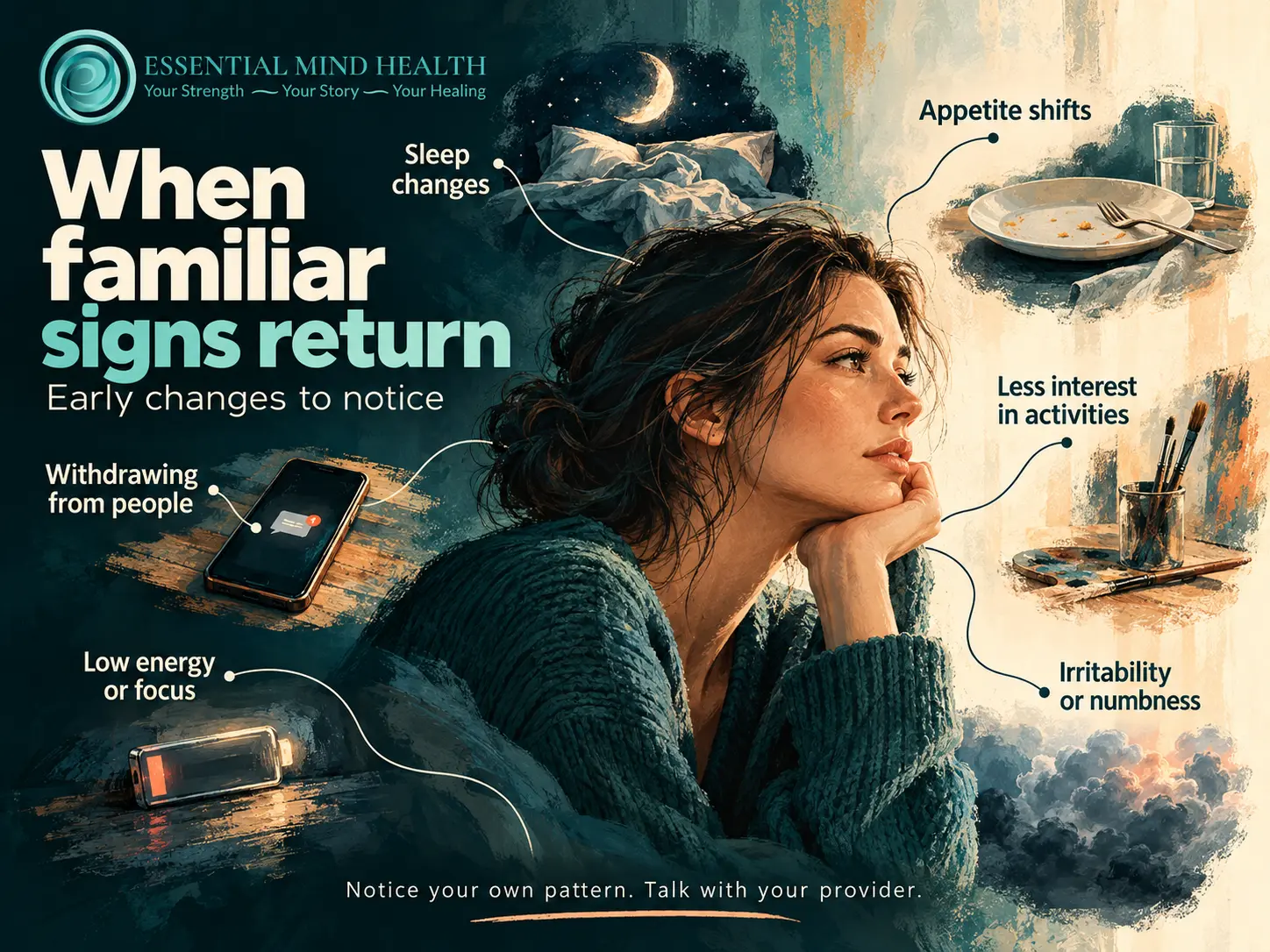
What are the early warning signs that depression is returning?
Usually they look like the start of your last episode, only smaller. That’s the best clue. Your own early pattern tends to repeat, so it’s worth knowing it.
Common early signs include:
- sleep changing, either way (can’t fall asleep, wake at 4 a.m., or sleep far more than usual)
- appetite shifting
- pulling back from people or plans you’d normally keep
- losing interest in things that were fine last month
- feeling tired for no clear reason
- trouble focusing
- getting short-tempered or numb, not sad
That last one catches people out. Depression doesn’t always show up as sadness. Some people get irritable or flat and empty instead, and our post on why depression sometimes shows up as irritability or numbness goes through that. Fatigue can be an early sign too, and you can read more in why depression makes you tired and the physical symptoms of depression. If you want the full list of what to watch for, our guide to hidden signs of depression is a good place to start.
A trick that helps: write your own list. Think back to the weeks before your last episode. What changed first? That’s your list. Share it with someone close to you, because other people often spot it before you do.
What can set off a return?
Often there’s no single trigger. Sometimes depression comes back and nobody can point to why. Still, a few things show up again and again.
Stress and big changes top the list. A move, a job loss, a breakup, a new baby, a death. Even good changes can wear you down. Sleep is another. A few bad nights in a row can tip things, especially if you’ve got a history, and our post on how sleep and mental health feed each other explains the loop.
Alcohol and drugs generally make depression worse and harder to treat over time. Darker months bring a pattern for a lot of people, which our piece on seasonal depression vs the winter blues covers. And then there’s stopping treatment too soon. That one deserves its own section, so here it comes.
Does stopping antidepressants make depression come back?
It can. Stopping a medication suddenly, or drifting off it once you feel fine, can bring symptoms back. It can also cause withdrawal-like symptoms, and quitting abruptly may worsen depression.
So the standard advice is simple. Don’t stop an antidepressant without talking to your provider first. If it’s time to come off, the dose is usually lowered gradually, and the way that’s done depends on the medicine. Withdrawal-type effects are usually mild and short-lived when the dose is reduced gradually, often a week or two, though they can occasionally be more severe. If they don’t ease or they get worse, contact your provider.
Here’s a point people miss. “I feel fine” is exactly when many people want to stop, and it’s also when stopping is most tempting and most risky. Feeling fine often means the medication is doing its job. It doesn’t always mean you no longer need it.
At Essential Mind Health, the same message applies from the start: don’t stop a medication suddenly just because you’re not seeing results yet, or because you’re doing better. Stopping abruptly can cause unpleasant effects, so talk to us first. Our guide to depression treatment options for adults covers how the options fit together.
How long should you stay on treatment after you feel better?
Longer than most people expect, and it’s different for everyone.
A common guideline is to keep taking an antidepressant at the same dose for at least 4 to 6 months after symptoms have eased. If you’ve had depression before, longer-term treatment may be advised, and it should be reviewed regularly to see whether you still need it. Long-term maintenance treatment is a recognized way to help prevent a relapse.
The evidence backs this up. In a review of 15 maintenance trials in adults with depression, people who kept taking the antidepressant after they’d responded had far fewer relapses than people switched to a placebo. On average the relapse rate dropped by about half.
That doesn’t mean everyone stays on medication forever. Plenty of people taper off and stay well. It means the decision deserves a real conversation instead of a quiet fade-out. Things to talk through with your provider include how many episodes you’ve had, how severe they were, how long you’ve been well, what else is going on in your life right now, and what you’d rather do.
Can therapy help keep depression from coming back?
It can, and it works well alongside medication. Combining an antidepressant with talk therapy can help prevent depression from returning once you’re feeling better. It’s one reason staying with therapy after you feel better is worth considering, even if sessions get less frequent.
For people who’ve had several episodes, there’s also some evidence for a type of group therapy called mindfulness-based cognitive therapy. In one large trial of adults with three or more past episodes, it did about as well as staying on antidepressants at keeping depression away. Roughly 44 out of 100 people in the therapy group relapsed, compared with 47 out of 100 on medication, a difference that wasn’t statistically meaningful. UK guidance has recommended it for people with several past episodes who are currently well. Access can be limited, though, since trained therapists aren’t available everywhere.
At Essential Mind Health, our provider refers patients to therapists who fit what they need, and stays in touch with them. If this kind of approach interests you, ask. Our posts on the benefits of cognitive behavioral therapy and how therapy works explain what to expect from the sessions themselves.
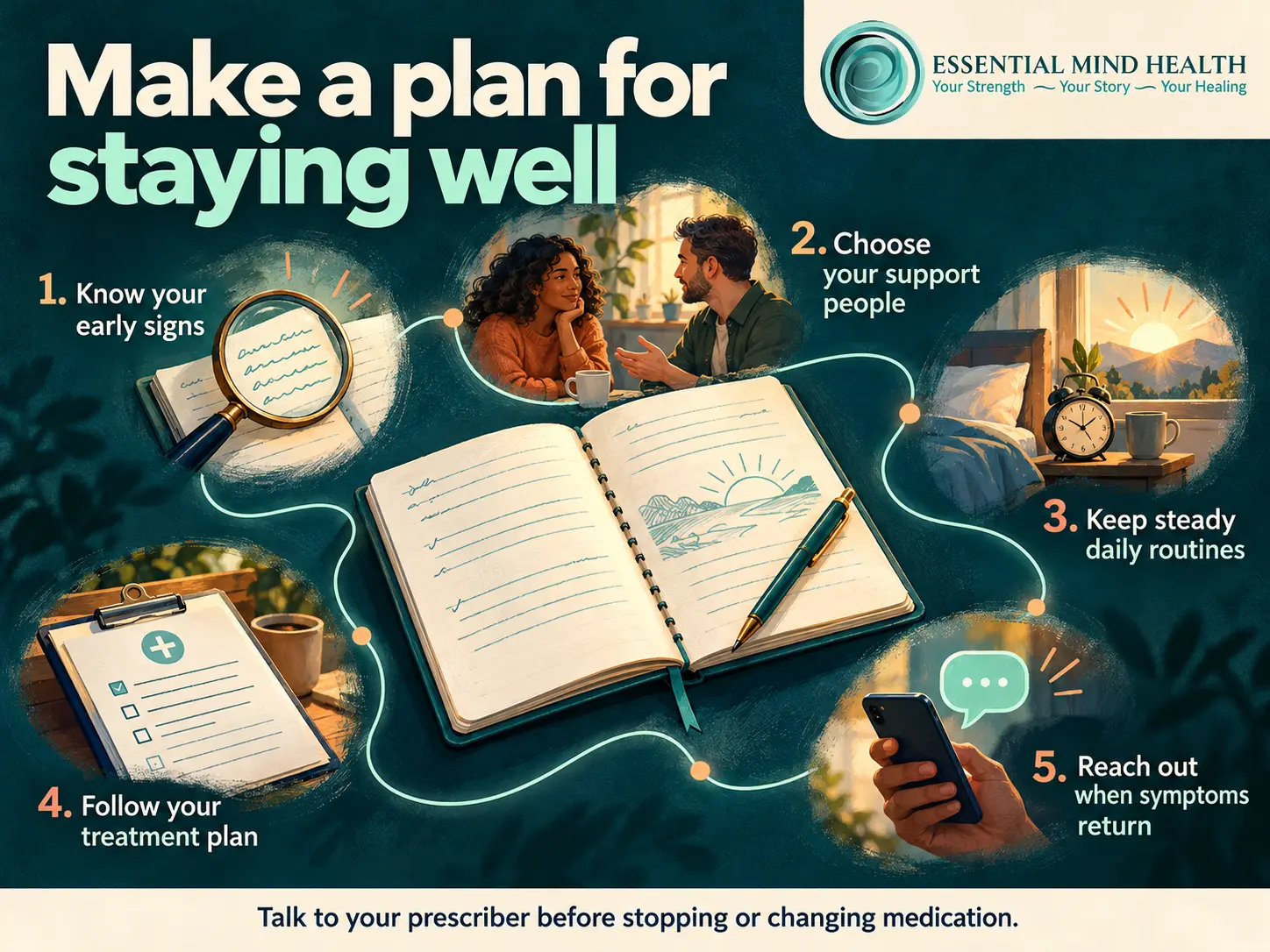
What goes into a plan for staying well?
A plan beats willpower. Worked out while you feel okay, it saves you from making decisions when you don’t.
Keep it short. A page, or even a note on your phone.
Start with your early signs, the three or four things that show up first for you. Sleep, appetite, withdrawing, irritability, whatever your pattern is. Then add the people you’ll tell, and what you’d like them to watch for. Relatives and friends can help notice changes, and it’s much easier if they know ahead of time that you want them to speak up.
Next, decide your threshold. When will you call your provider? A decent rule of thumb: if the signs last more than a couple of weeks, or they start getting in the way of work, sleep or relationships, book the appointment. Don’t wait for it to get bad.
Then the anchors, meaning the habits that keep your days steady. Regular sleep and wake times, some movement, time with people, limiting alcohol. None of these replace treatment. They help it work. Last, jot down your medication notes: what you take, how long you’ve been on it, and a reminder that it shouldn’t be stopped suddenly.
Review the plan with your provider now and then. People change, and what worked last year might need updating.
What habits help keep depression from returning?
No habit makes you immune. But some make things steadier.
Sleep is the big one. A regular schedule protects mood in ways that surprise people. Getting treatment at the earliest sign of trouble matters too. So does managing stress where you can, leaning on family and friends when things get hard, and building up the kind of resilience that comes from doing things you value. Skip the alcohol and recreational drugs when you’re vulnerable, since they tend to make depression worse.
If you’re also dealing with anxiety, it’s worth treating both. Our posts on depression and anxiety together and depression and anxiety treatment for adults explain how they overlap. And if exhaustion is part of the picture, emotional exhaustion is worth a look.
What should you do if it feels like it’s coming back?
Reach out sooner, not later. Depression can return after you’ve had treatment, and the advice is to get help as soon as symptoms reappear.
Here’s what that can look like.
Call your provider and say what you’ve noticed. Be specific if you can. Not “I feel off” but “I’m waking at 4 every morning and I’ve cancelled three things this week.” The more concrete you are, the faster a provider can work out what’s going on.
Expect questions. When did it start? What’s changed? Are you still taking your medication as prescribed? Any new stress, new medicines, alcohol? A provider may also check for physical causes, since problems like thyroid trouble, low vitamin D or B12, and anemia can look a lot like depression.
Expect an adjustment. A return often leads to a change in the plan, such as a dose change, a different medication, adding therapy, or more frequent check-ins. Some people worry a return means starting over. It usually doesn’t. You already know what helped.
If you’ve been on treatment and it’s no longer working, that’s worth saying plainly. Not every first approach is the right one, and that’s normal.
One more possibility: it might not be what you think
Sometimes returning depression is part of a bigger pattern. A provider may ask about stretches of unusually high energy, little need for sleep, or racing thoughts, since bipolar disorder can show up first as depression. Our post on bipolar I vs bipolar II explains why that matters.
Other things can mimic or worsen depression too, including sleep problems, medical conditions, some medicines, and substance use. A good evaluation looks at all of it.
When to get urgent help
If you have thoughts of harming yourself or ending your life, don’t wait for an appointment. Call or text 988, the Suicide and Crisis Lifeline, right away. If you’re in immediate danger, call 911.
Video visits aren’t an emergency service, so please use emergency care when you need it.
Getting help for returning depression at Essential Mind Health
If depression is back, or you’re worried it might be, our online depression treatment in West Palm Beach is a place to start. Visits happen by secure video from home or work, anywhere in Florida. You need to be physically in Florida during the visit.
Jennifer Caschetta, PMHNP-BC, a board-certified psychiatric nurse practitioner, leads the practice. A first visit is built around a conversation. She asks about how long symptoms have lasted, your sleep, appetite, routines, family history and substance use, and may use a short questionnaire to score severity and track progress over time. She may also suggest blood work to check for physical causes. Early follow-ups are closer together while medication takes effect, then they spread out as things settle.
If you’d rather be seen in person, there’s a clinic in Jupiter, and our depression therapy in Jupiter page has the details. We also serve Palm Beach Gardens and the surrounding area online, with a hub for mental health care in West Palm Beach and one for Palm Beach Gardens. To see how remote care works, read what online mental health care looks like, meet our provider on the provider page, or contact us to book.