

Plenty of men go through their twenties, thirties, even their fifties thinking the problem is them. They’re “bad with deadlines.” They’ve got a short fuse. They can’t sit through a meeting, lose their keys twice a day, start six projects and finish one. Friends call it a personality quirk. Bosses call it an attitude problem. Nobody says ADHD, because the picture most people have is a hyper eight-year-old boy who can’t stay in his seat.
That picture is old, and it leaves a lot of adult men out of it.
This post covers what ADHD actually looks like in grown men, why it so often gets read as something else (anger, laziness, burnout, “just stress”), and what getting answers and help can look like. If you read it and see yourself in a few of these, that’s worth taking seriously. It isn’t a diagnosis. But it is a reason to talk to someone.
What is ADHD in men, and is it different from ADHD in women?
It’s the same condition. The core of it doesn’t change: a lasting pattern of inattention, hyperactivity and impulsivity that gets in the way of daily life in more than one area, like work, home or relationships.
The differences are smaller than the internet makes them sound. In one large clinic sample of adults, researchers found that ADHD showed up in a “remarkably similar” way in men and women, and the gaps they did find were small. Men reported more run-ins with police or courts and more car accidents or lost licenses from reckless driving. Women reported more struggles with self-confidence and free time. Neither list is a rule. Plenty of men have the self-doubt and plenty of women have the speeding tickets.
Girls with ADHD are more likely to have the inattentive kind, which is quieter and easier to overlook, and that’s one reason women get diagnosed later. Boys are flagged more. Among children, about 13% of boys have been diagnosed compared with about 7% of girls. By adulthood, that gap in diagnosis starts to even out.
So why write about men at all? Because being noticed as a kid doesn’t mean being understood as an adult. And a man who wasn’t flagged early, or whose symptoms changed shape as he got older, can fall through the cracks in a different way. If you want the other side of this, ADHD in women covers how it tends to hide there.
What does ADHD look like in adult men?
Less like bouncing off the walls and more like a steady, low-level struggle with the basics.
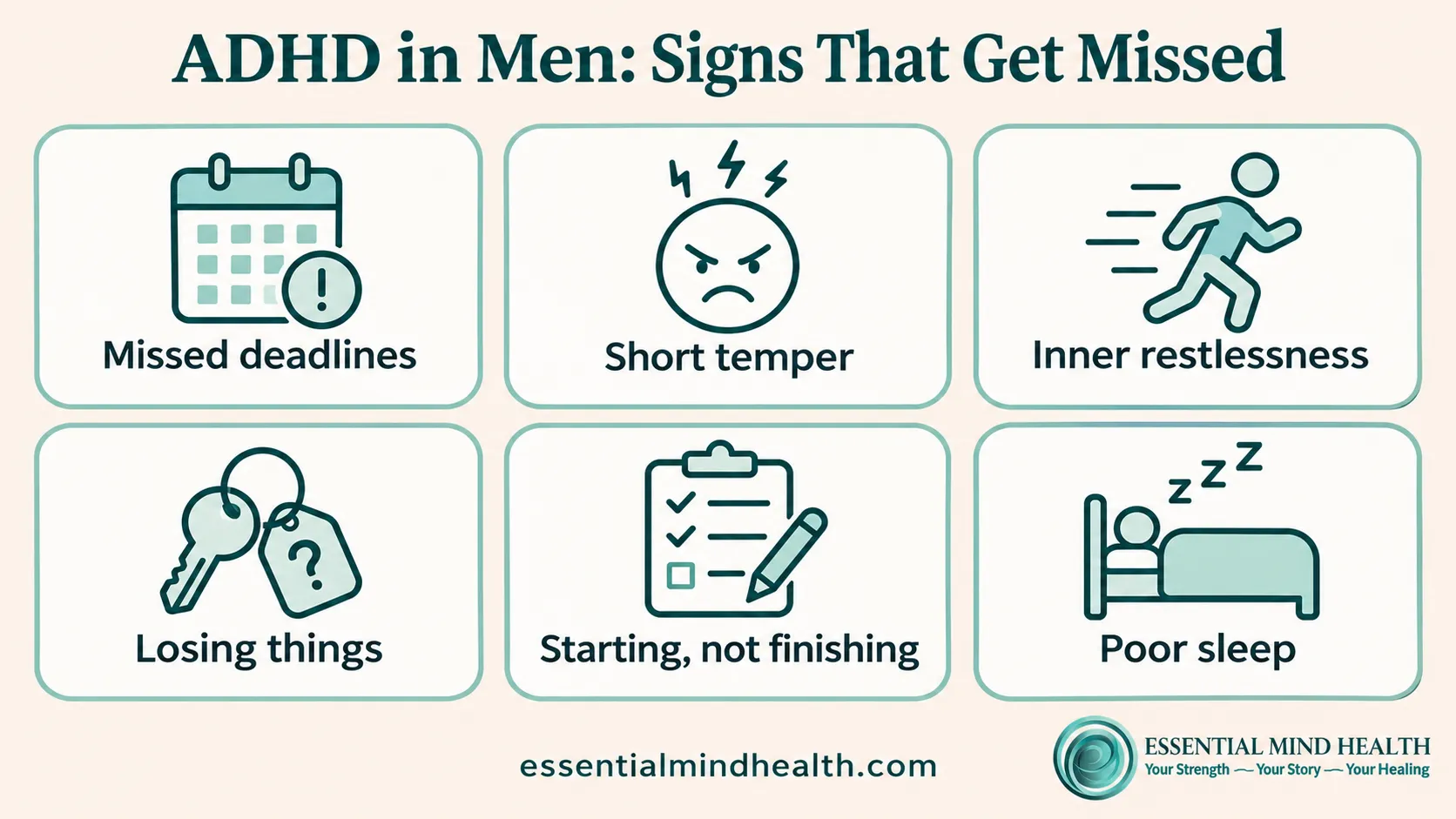
Hyperactivity tends to fade with age, while inattention often sticks around. So a boy who couldn’t stay in his chair may grow into a man who stays in the chair but can’t stay still inside. The restlessness goes underground. It turns into pacing during calls, tapping, fidgeting with everything, a need to always be doing something, or an inability to relax on a day off without feeling like you’re wasting it.
Beyond that, the usual adult signs show up. Trouble organizing tasks and deciding what comes first. Poor time management, which can mean running late all the time or having no real feel for how long things take. Losing things. Starting and not finishing. Zoning out in the middle of a conversation. Acting or speaking before thinking, which can sound like interrupting, blurting, making a quick call you regret by evening. Low patience when things don’t go smoothly. Mood that swings faster than the situation seems to warrant.
For a diagnosis, the symptoms have to be more frequent and more severe than what most people deal with, they have to have been around for at least six months, and some have to have started before age 12. Adults need five symptoms instead of the six children need. And they have to cause real trouble in more than one part of life. Everyone loses their wallet once in a while. That alone isn’t ADHD.
Here’s a quick reference for how common ADHD signs in men can get misread.
| Area of life | How ADHD can show up | What it often gets mistaken for |
|---|---|---|
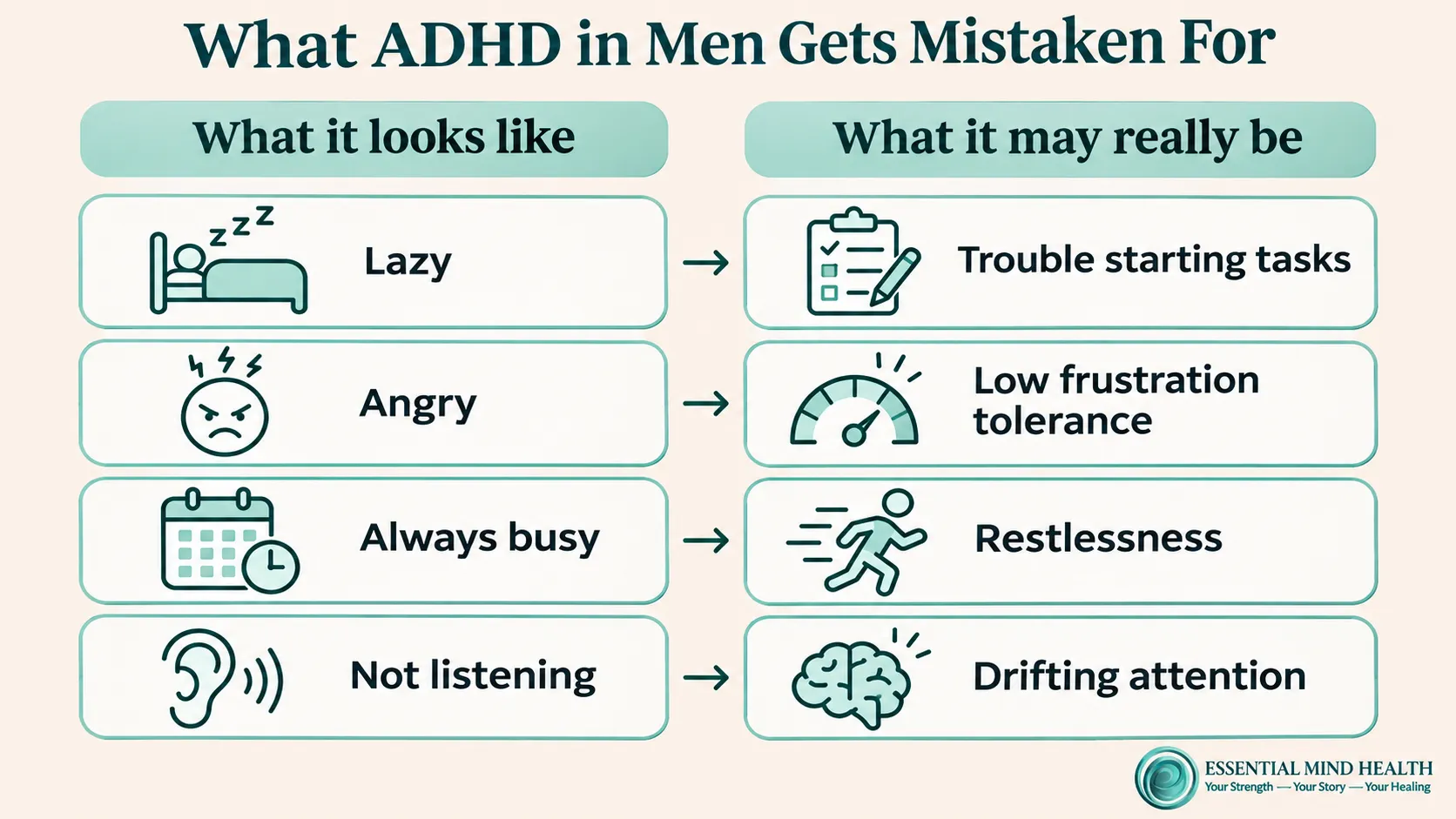
| Work | Missed deadlines, unfinished projects, poor time management, losing track of tasks | Laziness, not caring, poor attitude |
| Mood | Low frustration tolerance, quick temper, frequent mood swings | An anger problem, stress |
| Restlessness | Fidgeting, pacing, trouble relaxing, always needing to be doing something | Being “driven” or high energy |
| Impulsivity | Interrupting, blurting, quick decisions, risky driving, money trouble | Recklessness, irresponsibility |
| Relationships | Forgetting plans, drifting off mid-conversation, not following through | Not listening, not caring |
| Sleep | Trouble winding down, restless nights, feeling unrested | Insomnia on its own, stress |
| Mood and self-image | Ongoing frustration, guilt, low self-worth, anxiety or low mood alongside | Anxiety or depression only |
If you want a longer checklist, 15 signs of ADHD you should never ignore goes through them.
Why does ADHD in men so often look like anger?
Because frustration is where a lot of it leaks out.
Picture an ordinary day. You know what you’re supposed to do. You can’t make your brain start. Or you started and got pulled off track. Or you said something in the moment and it landed badly. Do that a few hundred times a year and you get tired, and tired plus frustrated turns into short-tempered fast.
Low tolerance for frustration, a quick temper and frequent mood swings are all part of how adult ADHD can look. The anger often isn’t about the thing in front of you. It’s about the pile behind it. And it’s usually followed by guilt, which feeds the next round.
This is also why ADHD gets mistaken for an anger problem. A man who snaps at his family gets labeled “angry” and sent toward anger management, which may help with some of the skills, but if the underlying ADHD is never named, the same pattern keeps repeating. Anger management therapy explains what that kind of work covers. And if irritability is the main thing you notice, anxiety can show up as irritability too, and so can depression. Sorting out which one is driving it (or whether it’s more than one) is part of a proper evaluation.
Why does ADHD get mistaken for laziness or a bad attitude?
Because from the outside, the results look identical.
A missed deadline looks the same whether someone didn’t care or couldn’t get started. A man who forgets what you said last night looks like he wasn’t listening. A man who spends four hours on the one task that interested him and none on the three that mattered looks like he’s choosing. Some adults with ADHD tend to grab the thing that pays off right now over the thing that pays off later, and that can read as irresponsible.
Years of that adds up. Poor work or school performance, financial trouble, strained relationships and a low sense of self-worth are all linked with adult ADHD. Many men don’t connect any of it to a condition. They just collect evidence that they’re a screwup. “I’m lazy” becomes a story they tell about themselves, and it’s one of the harder ones to shake.
Work is often where it shows first. Job changes, being passed over, losing a job, or a reputation for brilliant ideas and unreliable follow-through. If it’s gotten to the point of exhaustion, ADHD burnout describes what that looks like, and emotional exhaustion is worth a read too.
How can ADHD hide behind being “driven” or “busy”?
Some men with ADHD don’t look disorganized at all. They look intense.
They work all hours, say yes to everything, take on the hardest projects, and always seem to be in motion. From outside, that’s ambition. From inside, it can be a way of managing restlessness, or a way of leaning on deadlines and pressure to finally get the brain to engage. Then the structure gets taken away (a job change, a quieter season, working from home) and everything unravels.
It’s also common to build elaborate workarounds. Alarms for everything, a spouse or assistant who tracks the calendar, notes on the hand, the same three tools for years. Those workarounds can hide ADHD for a long time. They also take a lot of energy, and when life gets bigger (a promotion, a baby, a move), they stop being enough. Symptoms often grow when daily demands rise, and that’s frequently when people first look for answers.
This is the same reason ADHD can be mistaken for anxiety or depression: the stress and the low mood are real, and they sit on top of something that was never named.
What about risk-taking, driving and money?
ADHD in adults is linked with riskier behavior. Impulsivity is a big part of why.
The list of possible complications is worth knowing about, even though it can feel blunt. It includes frequent car accidents, legal trouble, money problems, and alcohol or other substance misuse. In that large clinic sample, men were more likely than women to report police or court contact and crashes or lost licenses from reckless driving, though the differences were small and plenty of men with ADHD never go near any of it.
None of that is destiny. It’s what can happen when impulsivity and inattention go unrecognized and unsupported for years. The reason to know the pattern is so you can catch it, not so you can worry about it. A man who keeps getting speeding tickets, impulse buying, or reaching for a drink to wind down might be dealing with more than bad habits.
If alcohol or drugs have become part of how you cope, tell the person you’re seeing. That’s not a side issue. Substance use and ADHD often travel together, and treatment works better when the provider knows everything.
How does ADHD affect relationships and family life?
Often more than the person with it realizes.
Forgetting plans, not following through, interrupting, drifting off mid-conversation, losing your temper over small things. From a partner’s side, that can feel like being ignored or like carrying everything alone. Unstable relationships are one of the known complications of adult ADHD, and a lot of men first hear about the possibility of ADHD because a partner or a child’s diagnosis made them look closer.
It goes both ways, too. A man who feels criticized all the time, at work and at home, can get defensive fast. That makes conversations harder, and the cycle keeps going. ADHD and relationship difficulties goes deeper on how this plays out and what helps.
How can partners and family help?
By getting curious before getting angry, if they can manage it.
It helps when the people around a man with ADHD know that forgetting and drifting aren’t signs he doesn’t care. Treatment works best with support, and the family is often the first to notice the pattern. A partner can sit in on an evaluation if he wants that, and can fill in what he doesn’t see himself, like how long it’s been going on or what he was like as a teenager.
Day to day, small shifts matter more than speeches. Shared calendars. One agreed place for keys and wallets. Asking for one thing at a time in place of five. Saying what’s bothering you when things are calm, not mid-argument. And, if he’s the one reading this, telling them what you’ve learned.
The same goes in the other direction. Being the person who always gets corrected is exhausting, and it chips away at how anyone feels about themselves. A little patience on both sides goes a long way while treatment gets going.
Does ADHD in men come with other problems?
Often, yes.
ADHD regularly shows up alongside anxiety, depression and other mood conditions, and those can make treatment trickier. Sleep problems are especially common. Up to 70% of adults with ADHD have them, which can mean trouble falling asleep, a brain that won’t shut off at night, or never feeling rested. And poor sleep makes everything else worse: focus, mood, patience. Sleep and mental health explains how those feed each other, and why you can feel tired after sleeping covers the exhaustion side.
ADHD is also linked with a higher chance of anxiety, depression and suicidal thoughts. If life has been feeling heavy for a while, say so out loud during an evaluation. A provider needs to know about the mood part, and it may be what’s been driving most of the misery. Depression and anxiety together is a good place to start if that sounds familiar.
How is ADHD in men diagnosed?
Through a full evaluation. There’s no blood test or scan for it.
A provider will ask about your symptoms now, what you were like as a kid, how things go at work and at home, your sleep, your mood, and anything else going on. They’ll often want input from someone who knows you, like a partner, a parent or an old report card, because childhood history matters. Other things can look like ADHD, including anxiety, depression, sleep problems and thyroid issues, so ruling those in or out is part of the process.
If you’re curious about the details, how adult ADHD is diagnosed walks through it step by step.
It’s never too late to ask. Many people get their diagnosis in their thirties, forties or later, and it can be a relief more than a label: a lot of old confusion suddenly has an explanation.
What helps ADHD in men?
Treatment usually combines a few things, and what works varies from person to person.
The two main approaches are medication and talk therapy. Therapy, especially cognitive behavioral therapy, helps with the practical side: building routines, breaking tasks into steps, handling frustration, changing the harsh way you talk to yourself after a mistake. Medication, which a provider prescribes and monitors, can help with focus and impulse control. Most people do best with both, and it can take some trial and adjustment to land on what fits.
Around those, a few things make a real difference. Regular exercise. Steady sleep. Daily task lists and reminders. Smaller steps in place of giant projects. Some adults work with an ADHD coach to build the planning and organizing skills that don’t come naturally. If the condition affects your job, you may also be able to ask for reasonable accommodations at work.
Small, boring habits tend to beat big resolutions. Put your keys in one spot. Set a single reminder you actually trust. Tell the people closest to you what’s going on so they can stop reading your forgetfulness as disrespect. Try pausing for ten seconds before you answer when you feel your temper rising. None of this replaces proper care, but it takes pressure off while you get it.
At Essential Mind Health, ADHD care is available through ADHD treatment in Jupiter, and online through ADHD treatment in Palm Beach Gardens and ADHD treatment in West Palm Beach. If sleep is part of what’s wearing you down, there’s insomnia treatment in Palm Beach Gardens and in West Palm Beach as well.
When should you reach out for help?
When it’s costing you something and it’s been going on a while.
If the symptoms keep getting in the way of work, your relationships or how you feel about yourself, that’s reason enough. So is a pattern you keep trying to fix on your own and can’t. You don’t need to be sure it’s ADHD before you ask. Other things can look similar, and sorting that out is the provider’s job, not yours.
Look for someone with training and experience in adult ADHD. And bring all of it: sleep, mood, drinking, temper, work, home. The more honest the conversation, the more useful the result.
If things ever get dark and you’re thinking about hurting yourself, call or text 988 or call 911 right away. You don’t have to wait for an appointment.