

Nobody can diagnose ADHD in an adult with a blood draw or a scan. There isn’t a single questionnaire that does it either. What happens instead is a clinician sits down with you, hears how things have gone for years, checks your symptoms against a set list, and tries hard to see whether something else fits better. For adults the bar is five symptoms from the inattention group or the hyperactivity and impulsivity group. They need to go back to before age 12, and they have to be messing with your life in more than one place, say work and home.
Okay, that’s the quick version. People usually want the rest before they book anything. What will they ask me? Do I have to dig up my school records? Can I fail a test? Will video work? So that’s what this post covers, plus what to pull together beforehand and what it means if the answer isn’t ADHD after all.
Is there a test for adult ADHD?
No lab test, no brain scan, no single score. Sleep problems, anxiety and depression can all look a lot like ADHD, which is a big reason the evaluation is a process and not a one-shot exam.
Online quizzes get asked about constantly. They’re fine for one thing: telling you it might be worth getting evaluated. They can’t confirm ADHD and they can’t rule it out. If you scored high on one at 2 a.m., treat it as a nudge to book a visit and leave it there.
Inside a real evaluation you’ll probably fill out a rating scale or two. Those ask how often you lose the thread of a conversation, fidget, put off anything that needs steady effort. The clinician doesn’t just add up a score. They read your answers next to what you say out loud and what your history shows.
Some adults also do longer psychological testing, things like memory, planning and reasoning tasks. It can point out strengths and flag learning difficulties. Plenty of people get diagnosed without it, and your provider will say whether it would add anything for you.
What has to be true before an adult gets diagnosed?
Clinicians work from the DSM-5-TR. Here’s how it plays out.
Symptoms sort into two groups. Inattention is the missed details, the drifting off mid-conversation, the lost keys, the five half-finished projects. Hyperactivity and impulsivity is restlessness, cutting in on people, acting first and thinking later. Adults need five from one group. Kids need six.
Then there’s timing. Symptoms had to be around before age 12. Nobody’s asking whether you were diagnosed back then (most adults weren’t), only whether the traits were there.
They also have to show up in more than one setting. If you only struggle at one particular job and everything else runs fine, the explanation probably lives somewhere else.
And they have to cost you something: deadlines, relationships, money, a career that keeps stalling. Habits that never interfere with anything don’t count.
Last piece, no other condition explains them better.
One thing catches adults off guard. Hyperactivity tends to fade with age, but the restlessness, impulsiveness and attention trouble often stay. So the kid who couldn’t sit still turns into an adult who looks perfectly calm and feels like their head has fourteen tabs open. Symptoms that are brand new, or that come and go every so often, usually point somewhere other than ADHD.
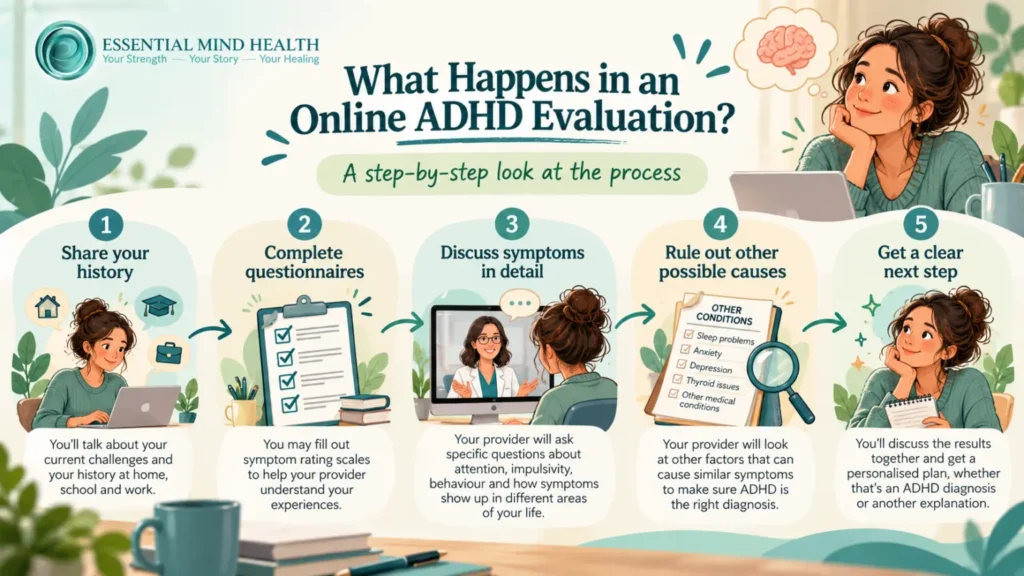
What happens in an ADHD evaluation visit?
Mostly it’s a conversation. A longer, more specific one than a regular check-in.
You’ll probably start with what pushed you to come in. Then the provider will want examples, because “I’m disorganized” doesn’t tell them much. What went wrong last week? What does your inbox look like right now? How do you handle a task that’s boring and due Friday? What happened the last time you missed something that mattered?
After that comes the wider history. Work, school, family. Past diagnoses. Sleep, mood, how much coffee and alcohol. Medicines you take now and ones you’ve tried before. Medical conditions. Whether a parent, sibling or other blood relative has ADHD or another mental health condition, since ADHD tends to run in families.
A rating scale or two will come into it. Some providers send those ahead so the appointment itself goes to talking.
At the end you hear what the provider found. Sometimes it’s a clear yes. Sometimes it’s “probably, but I’d like one more piece,” and that piece could be an old report card or a phone call with someone who knew you as a kid. A second visit isn’t a red flag. Usually it means the evaluation is being done carefully.
Why does the clinician keep asking about your childhood?
Because the criteria say symptoms started before 12, and an adult diagnosis leans on what happened a few decades back.
Nobody remembers age nine well. You’re not expected to. Teacher comments on old report cards are weirdly useful (“bright but doesn’t apply himself,” “talks constantly,” “loses everything”), and so is a parent’s or older sibling’s memory. With your okay, a provider may talk to someone who knows you well, and may look at school records if you’ve got them.
If you’ve got nothing, you can still be evaluated. Your own memories count. So does a lifelong pattern that can’t be pinned on something that started recently.
This is also why so many adults get diagnosed late. Adult symptoms are often less obvious than a child’s. Inattentive symptoms are quiet compared with a kid bouncing off the walls, and ADHD is often missed in women for that reason. If that rings a bell, our posts on ADHD in women and adult ADHD symptoms in women get into how it hides.
Will the clinician talk to anyone else in your life?
Maybe, and only if you’re comfortable with it. A partner, parent or close friend can often spot patterns you can’t: how often plans change at the last minute, how often you zone out mid-sentence, how you hold up under stress at home.
It’s not required. Plenty of people come alone and that’s enough. If you do ask someone, have them write down two or three specific examples first. “He forgot our anniversary dinner reservation twice this year” helps. “He’s always been like this” doesn’t help much.
If ADHD is already straining things at home, our post on ADHD and relationship difficulties covers the patterns couples bring up most.
What else gets checked before ADHD is diagnosed?
More than people expect. It’s honestly the part of the evaluation that surprises them most.
Attention problems have a lot of sources. Anxiety scatters focus. Depression drags concentration and energy down together. Bad sleep makes anyone forgetful and snappy. Learning difficulties, bipolar disorder, and some medical conditions and medicines can overlap with ADHD or affect thinking and behavior on their own. So the clinician has to ask whether ADHD is the best fit or just one candidate.
It runs the other direction too. ADHD doesn’t directly cause anxiety or depression, but they show up together often, and years of falling short at work or at home can feed both. Mood disorders, anxiety disorders and learning disabilities are among the conditions that commonly sit alongside it. Catch only one of them and the other can keep going untreated.
We’ve written about this overlap. Why ADHD gets mistaken for anxiety or depression is the one to read if you’ve been treated for either without much change. Sleep is its own thread, covered in how sleep and mental health feed each other, and so is the way depression and anxiety travel together. If big mood swings are part of the picture, bipolar I vs. bipolar II lays out how those get told apart.
When one of those is in the mix, care for it can run alongside ADHD care. Essential Mind Health has pages for anxiety, depression, insomnia and bipolar disorder too.
What should you gather before your evaluation?
You don’t need to prepare much. A bit of homework helps the visit go further, though.
Start with examples. Jot down three or four real moments from the last month when attention, restlessness or impulsiveness got in your way. A missed bill. A project you couldn’t start. An argument that began with you interrupting. Specifics beat generalities every time.
Then childhood. Report cards, a teacher’s note, a parent’s memory of what school was like. If nothing survives, ten minutes on the phone with your mom can fill in a surprising amount.
Make a list of everything you take, prescription or not, along with your caffeine and alcohol habits. Add earlier diagnoses, therapy, or medication trials, and roughly why they ended.
Think about family too. Anyone with ADHD, anxiety, depression, bipolar disorder, learning problems? Even “my uncle never held a job for long and everybody called him scattered” is worth saying out loud.
And be straight with the provider. Don’t try to match a symptom list. Don’t downplay, either. If you can’t tell whether something counts, say that and let them ask follow-ups.
Can an ADHD evaluation be done online?
For most adults, yes. So much of it is conversation and questionnaires that a secure video visit covers the history, the examples, the rating scales and the discussion afterward fine.
What video can’t do is a physical exam or lab work. If your provider wants to rule out a medical contributor, that part may go through your primary care provider, and the two of them can compare notes.
At Essential Mind Health, patients physically in Florida can be seen by secure video, with in-person visits at the Jupiter clinic. If you’re in Palm Beach Gardens or North Palm Beach, our online ADHD treatment in Palm Beach Gardens page shows how visits are set up. The online ADHD treatment page for West Palm Beach does the same for that area, and ADHD therapy in Jupiter covers the clinic. For a sense of how a video visit actually runs, see what online mental health care looks like in Palm Beach County.
A composite visit: the 34-year-old who thought she was just disorganized
This is an illustration, not a real patient.
Dana is 34 and works in operations for a company in Palm Beach County. She’s good at the job and worn out by it. There’s a color-coded planner she never opens. She’s late nearly every day and has lost two phones this year. She’d decided she was lazy, maybe a bit anxious. Her sister got diagnosed last spring and told her to get looked at.
In the visit the provider mostly listens. Dana describes finishing everything in a panic the night before it’s due. She mentions her second grade teacher wrote “daydreams constantly” on every report card, and that her mother still laughs about the year she lost four jackets. She never got in trouble. She was just always a step behind.
Questions come about sleep (poor), mood (flat some weeks, not all), alcohol (a glass of wine most nights) and family (her sister, plus a father who “never finished anything”). Dana fills out a rating scale. The provider asks if her mother would answer a few questions by phone.
By the end of the second visit there’s enough to talk through. A lifelong pattern of inattentive symptoms, some anxiety layered on top, and sleep that needs its own attention. Nobody hands her a label and a prescription at the door. They sort out what to tackle first.
That’s roughly how it goes. Gather, check, talk it over.
What if the answer isn’t ADHD?
It happens, and it’s still a useful answer. The symptoms that brought you in are real whatever’s behind them.
Maybe it’s anxiety. Maybe it’s depression that’s been running for years without a name, or sleep that’s been wrecked for ages, or a mix of all three. A clear “no, here’s what’s more likely going on” points care at the actual cause. Chasing the wrong diagnosis can mean months of treatment that never lands.
Our posts on emotional exhaustion and ADHD burnout cover two places people often end up.
What happens after an ADHD diagnosis?
ADHD treatment usually involves medication, psychosocial treatment, or both. Cognitive behavioral therapy is one of the approaches used, and so are practical changes to how work and home run: adjusted deadlines, routines that cut down the number of decisions you make in a day, reminders placed where you’ll actually see them.
The specifics get worked out with your provider, based on your symptoms, any other conditions, and what you most want to change. Our post on cognitive behavioral therapy explains what sessions look like. And if you want to see how ADHD tends to show itself before anyone names it, 15 ADHD signs you shouldn’t ignore is a good place to start.
Starting an ADHD evaluation with Essential Mind Health in Palm Beach County
If you’re in Jupiter, Palm Beach Gardens, West Palm Beach or nearby and you’ve wondered whether ADHD explains the last ten years, the first move is a visit. Our mental health care in Palm Beach Gardens and mental health care in West Palm Beach pages show what we see people for, and you can read about our provider before you book.
To set up a visit, contact us.