

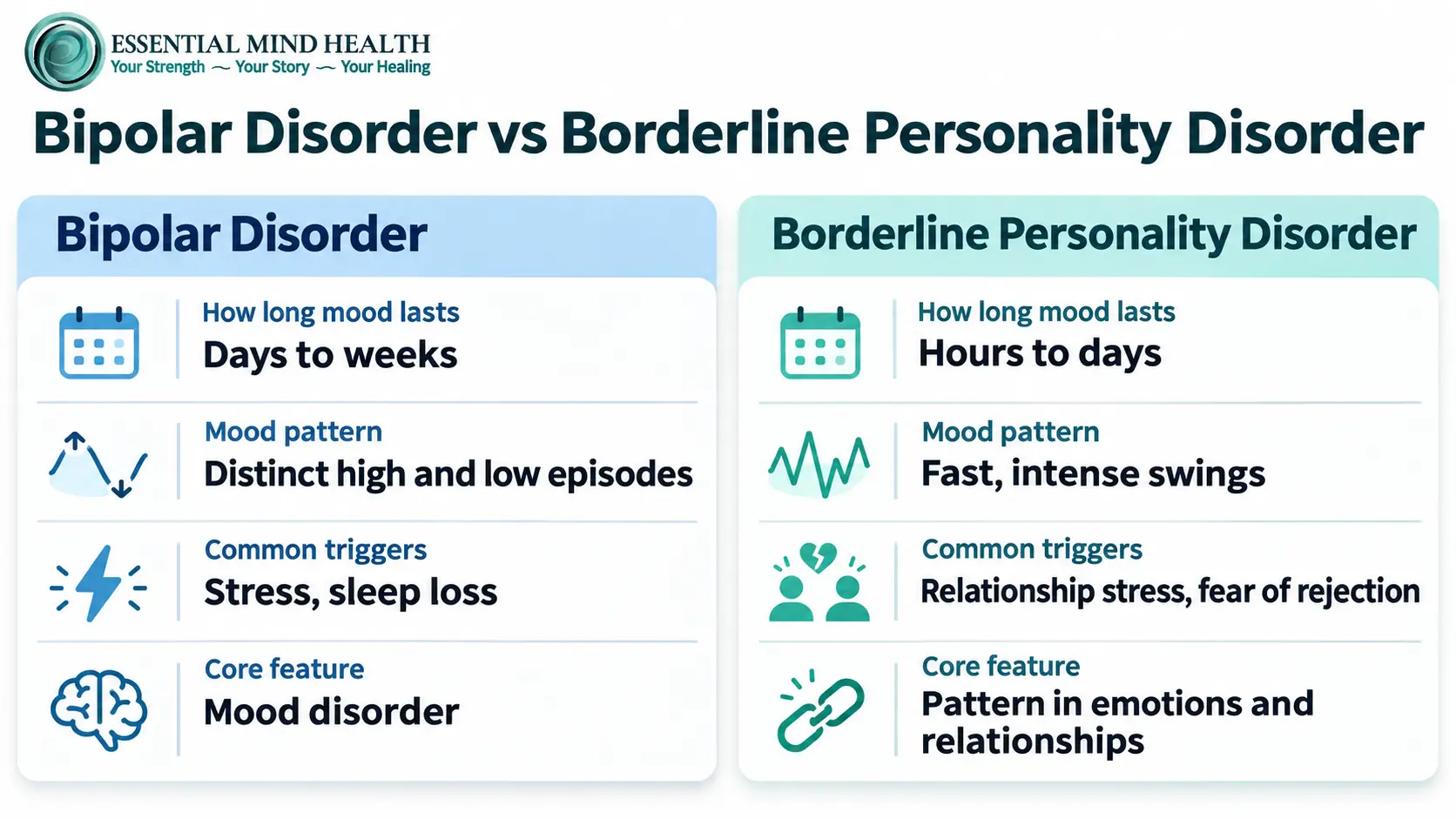
Bipolar disorder and borderline personality disorder are two different conditions that can look alike from the outside. Both can bring sharp mood changes, anger, impulsive choices and thoughts of self-harm. The biggest differences are how long a mood lasts, what sets it off, and what sits at the core: bipolar disorder is a mood disorder made of distinct episodes of high and low mood, while borderline personality disorder is a pattern in how a person feels about themselves, relates to other people and reacts emotionally.
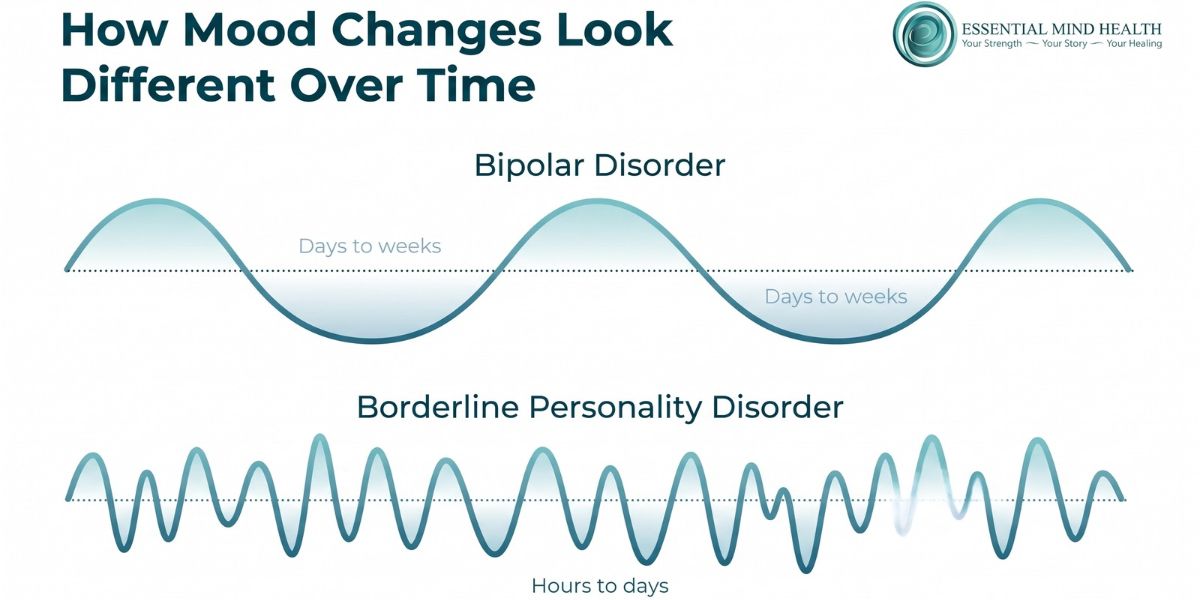
A bipolar mood episode usually runs for days or weeks. The emotional shifts in borderline personality disorder often come and go within hours or a few days, and they tend to follow something that happened between people. Only a full evaluation can show which pattern is present, and some people have both conditions, so a list of symptoms is a starting point for a conversation and never a diagnosis.
What is the difference between bipolar disorder and borderline personality disorder?
Starting with what a condition is built on may also help to differentiate the two conditions. Bipolar disorder is made up of episodes. Episodes of mania and/or hypomania, depression, and other symptoms in between may last weeks to months, and mood returns to normal in between these episodes. Borderline personality disorder is not made of episodes at all and is a lasting pattern that may include intense and unstable moods that may happen quickly and change a lot within the same day.
Triggers differ too. Stress, short sleep, and drug or alcohol use can bring on a bipolar episode, and then it plays out over days and weeks. BPD swings usually follow something between people, mostly real or feared rejection and abandonment, and they can ease within hours.
Here’s the comparison in one place.
| Bipolar disorder | Borderline personality disorder | |
|---|---|---|
| Core feature | A mood disorder with episodes of mania or hypomania and episodes of depression | A pattern of unstable emotions, self-image and relationships, with a strong fear of abandonment |
| How mood changes | Shifts into distinct high or low episodes, then usually returns to baseline | Intense, highly variable moods that can change within the same day |
| How long changes last | Days to weeks. Mania in bipolar I lasts at least 7 days, and depressive episodes usually last at least 2 weeks | A few hours to a few days |
| Typical triggers | Stress, too little sleep, and drug or alcohol use can bring episodes on | Often tied to relationship events, especially real or feared rejection or abandonment |
| Relationships and self-image | Work and relationships can suffer during episodes | Intense, unstable relationships and a shifting sense of self are central |
| Impulsive behavior | Spending, risky decisions and similar behavior mostly during manic or hypomanic episodes | Can show up outside periods of elevated mood |
| Self-harm and suicidal thoughts | Thoughts of suicide are common | Self-harm and suicidal thoughts occur at a significantly higher rate than in the general population |
| Usual first treatment | Medicine and talk therapy together | Psychotherapy, with medicine added only for specific symptoms |
What is bipolar disorder?
Bipolar disorder, previously referred to as manic depression, is a condition that causes shifts in mood, energy, and concentration that people around them are able to notice. There are two main categories, mania and depression.
Mania is the mood category that is elevated. People that experience this feel as if they are ‘wired’ or electrified. People that are in this state are often times elated or highly irritable. A person in this state often has increased activity levels. A less severe form of this is referred to as hypomania. If the mania is of a milder state, a person may feel as if they are in an enhanced state. Often times, people in an enhanced state feel a boost in creativity and report that the state is enjoyable. However, people that are in this state may be diagnosed with a mental disorder due to the shift from their normal state. A person in a state of full mania may be psychotic and have a break from reality. People in this state often times require hospitalization.
A manic or hypomanic state consists of at least three of the following symptoms: increased energy and activity, needing less sleep, talking quickly, ideas racing, being distractible, making poor decisions and judgment, and being openly disregard of normal social boundaries.
On the low side, a major depressive episode needs five or more of the usual depression symptoms: a sad or empty mood, losing interest in nearly everything, sleeping too little or too much, feeling worthless or guilty, trouble concentrating, and sometimes thoughts of suicide. In bipolar disorder these are present most of every day for a week or two, sometimes longer, and the change shows in how the person acts.
Doctors split bipolar disorder into types. Bipolar I means at least one manic episode that lasts 7 days or more, or is severe enough that the person needs hospital care, with depressive episodes that usually last at least 2 weeks. Bipolar II has depressive and hypomanic episodes but never full mania, and it isn’t a milder bipolar I. It’s its own diagnosis, and many people with it spend long stretches in a low, grinding depression. The gap between bipolar I and bipolar II is bigger than the names suggest. Cyclothymia is the third type: repeated hypomanic and depressive symptoms that never reach the level of full episodes. Four or more episodes in a year gets the label rapid cycling.
Symptoms usually start in late adolescence or early adulthood. Bipolar disorder doesn’t go away by itself and generally needs treatment for the long haul, though treatment can improve how a person functions day to day. Adults who live near Jupiter can see how that care is described on the page for bipolar disorder therapy in Jupiter.
What is borderline personality disorder?
Borderline personality disorder (BPD) is a condition that is serious and affects how a person views themselves and other people. The main concern with this condition is how a person is able to control and manage their emotions. This oftentimes results in unstable relationships, self-image, and sense of identity. This condition is recognized by the mental health field, and therefore there are methods of treatment.
A strong fear of being abandoned sits underneath much of it. A person may go to extremes to avoid being left or rejected, even when nothing is happening that would justify the fear. They want close, lasting relationships badly, and that makes the fear hurt more. One day someone is perfect. The next day that same person doesn’t care enough.
Identity can move just as fast. Goals, values and interests change quickly, and a feeling of emptiness tends to hang around.
Emotions run hot. Moods can go from happy to irritable to anxious to ashamed, and they tend to last somewhere between a few hours and a few days. Anger can be intense or hard to rein in. Some people feel cut off from themselves or from the world around them, which is called dissociation. Impulsive behavior may mean spending sprees, dangerous driving, substance use, unsafe sex or binge eating. Self-harm and thoughts of suicide are part of the picture for many people with BPD. Nobody has every symptom, and how strong they are, how often they come up and how long they last all vary.
BPD usually starts by early adulthood and tends to be hardest in the young adult years. Mood swings, anger and impulsiveness often settle down with age. The self-image, abandonment and relationship problems usually stick around, so treatment aimed at those areas matters.
Why do bipolar disorder and BPD get mistaken for each other?
Mostly because the behavior looks the same from the outside. Someone snaps at a partner, spends money they don’t have, stays up three nights running, or talks about hurting themselves, and that could be either condition. Mood swings, irritability, anger, impulsive choices, risky behavior, self-harm and suicidal thoughts all turn up in both.
What separates them is the clock, and what the mood is actually doing. Bipolar episodes run for days to weeks, with symptoms there most of every day. BPD moods can flip inside a few hours and usually last somewhere between a few hours and a few days. Then there’s elevation. Impulsiveness is a key symptom of bipolar disorder and it’s common in BPD too, but when the spending sprees and dangerous driving cluster around stretches of unusually high mood or energy, that points to a mood disorder like bipolar. BPD symptoms show up without that significantly elevated mood.
Anger muddies things further. Irritability can be part of mania, intense anger is common in BPD, and depression in children and teens often looks like irritability instead of sadness.
Then there’s whatever else a person is carrying. Anxiety disorders, ADHD and post-traumatic stress disorder all appear on the lists of conditions that can sit alongside either one, and depression often travels with BPD. Stack a few of those together and the picture stops fitting any single label.
Bipolar disorder also hides well. Hypomania feels good, so people with bipolar II tend to ask for help when the depression hits while the hypomania goes unnoticed. Some go years before anyone puts a name to it.
What sets off mood changes in each condition?
Bipolar episodes often have a push behind them. Stress is one, whether it comes from a loss, a trauma or just being overloaded. Drinking or using drugs can make symptoms worse and bring them back. Sleep is probably the easiest thing to watch. Broken sleep often sets off bipolar instability, and a sudden drop in how much sleep a person needs is itself a sign of a manic or hypomanic episode, so sleep can be the trigger and the early warning at once. The link between sleep and mental health runs both ways in many conditions, but in bipolar disorder a steady sleep routine carries extra weight.
BPD triggers are mostly about other people. With a strong fear of abandonment and a high sensitivity to rejection, a sense that someone is pulling away, or getting too close, can set off sharp fear, anger or despair, and the mood can turn again within hours. The same fear can drive frantic attempts to avoid being left alone, and threats of self-injury often come in response to fears of separation or rejection.
Neither list covers everything, and stress touches both conditions. The difference is where a provider looks first. For episodes that last days, it’s sleep, routine and stress. For emotions that shift within hours, it’s relationships and perceived rejection.
Can a person have both bipolar disorder and borderline personality disorder?
Yes. BPD often occurs alongside other mental and physical conditions, including mood disorders like depression and bipolar disorder, and the conditions that can occur with bipolar disorder include borderline personality traits or disorders. The overlap makes diagnosis and treatment harder, especially when symptoms look alike.
When both are present, a provider is looking for two separate things. One is distinct episodes of significantly elevated mood that last days or longer, which point to bipolar disorder. The other is a long standing pattern of unstable relationships, a shifting self-image and fast emotional reactions, which points to BPD. Going back over the whole course of the illness, along with family history, helps show whether someone has bipolar disorder together with another disorder.
Having both means each one needs its own care. People with BPD should also be treated for the other mental health conditions that come with it, and bipolar disorder left alone makes everything harder to manage.
Can borderline personality disorder be misdiagnosed as bipolar disorder, or the other way around?
It happens. Some bipolar symptoms resemble other illnesses, and BPD overlaps with mood disorders through shared features like impulsive behavior. The bipolar side has a few extra traps. Thyroid disease and certain prescribed, recreational or illicit drugs can imitate or worsen mood symptoms. If depression gets treated with an antidepressant alone and the quiet signs of bipolar disorder were missed, a manic episode or rapid cycling can follow. To lower that risk, providers look at how symptoms have moved over the past days and weeks, and not only at what’s happening today.
A bipolar evaluation can include a physical exam and lab tests to look for medical causes, a mental health assessment, and mood charting, which is a daily record of mood and sleep. With the person’s permission, family members or close friends may be asked about symptoms. Children and teens with bipolar disorder often get another diagnosis first, like ADHD or behavior problems, and that complicates things.
BPD is diagnosed by a licensed mental health professional after a thorough conversation about symptoms and personal and family history, and a medical exam can rule out other causes. The diagnosis usually comes in late adolescence or early adulthood. Occasionally someone under 18 is diagnosed when symptoms are severe and last at least a year.
An online quiz can’t see how moods have moved over months and years. It can’t rule out thyroid problems or the effects of substances, and it can’t weigh family history. A qualified provider can do all three, which is the gap between an evaluation and a guess.
Self-harm and suicidal thoughts in bipolar disorder and BPD
Both conditions carry a higher risk. Thoughts about suicide are common among people with bipolar disorder, and people with BPD have a significantly higher rate of self-harm and suicidal thoughts and behavior than the general population. Anyone thinking about harming themselves or attempting suicide needs help right away.
If that’s you or someone you love, call or text 988 to reach the 988 Suicide & Crisis Lifeline, which is open 24 hours a day, seven days a week, or chat at 988lifeline.org. In a life-threatening situation, call 911. A hospital stay can keep a person safe during a crisis and help steady mood. Comments about self-harm or suicide always deserve to be taken seriously, and a quick call to a mental health professional or 988 is the right response.
How is bipolar disorder treated?
Medicine and talk therapy together is the usual approach, and it generally continues over the long term. The medicines doctors use most are mood stabilizers, which help control manic or hypomanic episodes and may help depressive ones too, plus antipsychotic medicines that work as mood stabilizers. Finding the right one takes trial and error. Some need weeks to months to reach full effect, and sometimes two or three are used at once. Stopping on your own can bring symptoms back or make them worse, even when you feel fine.
The depressive side of bipolar disorder gets handled differently from plain depression. An antidepressant may be added carefully, but it isn’t used alone, because it can set off a manic episode or rapid cycling. So the standard depression treatment options for adults don’t carry over unchanged.
Talk therapy is a vital part of care. Interpersonal and social rhythm therapy works on steadying daily rhythms like sleeping, waking and eating. Cognitive behavioral therapy helps a person find what triggers episodes and cope with stress, and a version built for insomnia can be especially useful for bipolar depression. Psychoeducation and family-focused therapy help the person and their family spot warning signs and stay with care. None of it is exotic. It rests on the same regular sessions and skill practice described in how talk therapy works.
When medicine and therapy aren’t enough, or a situation calls for a fast response, electroconvulsive therapy or transcranial magnetic stimulation may be considered. Day to day, a steady routine for sleeping, eating and physical activity, no alcohol or street drugs, and a mood chart all help.
Adults who want in person care can look at bipolar care at the Jupiter clinic, and people who’d rather be seen from home can look at online bipolar disorder treatment in Palm Beach Gardens or online bipolar disorder treatment in West Palm Beach.
How is borderline personality disorder treated?
BPD is mostly treated with psychotherapy and less with medicine. DBT is designed specifically with BPD in mind. It includes mindfulness, and helps to control intense emotions and reduces self-destructive behaviors. It also improves relationships. Mood swings and self-injurious behaviors can be alleviated with CBT by changing core beliefs which are usually based on faulty, incorrect views of oneself and others. A combination of therapies including Schema-focused, mentalization-based and transference-focused, when used along with group therapy and psychotherapy have been successful to change relationships.
The outlook on the use of medications is negative. FDA has approved no medications for BPD and benefits of medications for BPD are disputed and first-line treatments are psychotherapy. However, medications can be added for symptoms of BPD along with psychotherapy. Family members and caregivers are often affected by the symptoms of BPD and worsen the situations, and often therapy for them can help.
Recovery is a process that takes time and many improve with adequate psychotherapy for BPD, although not all can be completely relieved from symptoms. People who don’t get adequate treatment for BPD are at risk of developing chronic conditions. Outcomes depend on the mental health professional and treatment for BPD.
What causes bipolar disorder and borderline personality disorder?
Neither has one known cause. Research points to a mix of genetic, biological, environmental and social factors.
With bipolar disorder, genetics carry a lot of weight. It often runs in families, many genes are involved and no single gene causes it. Studies of identical twins show one twin can develop bipolar disorder while the other doesn’t, so genes aren’t the whole story. Differences in brain structure and function seem to play a part. A parent or sibling with bipolar disorder raises the risk, and periods of high stress, like a death in the family, drug or alcohol use and trauma can raise the risk or bring on a first episode. There’s more detail in the post on causes and risk factors of bipolar disorder.
With BPD, a close family member who has it raises the risk, and people with BPD may have changes in brain areas that control impulses and regulate emotions, though nobody knows yet whether those changes come first or follow the condition. Many people with BPD report painful experiences in childhood, such as abuse, neglect, abandonment or hardship, and others grew up around unstable, invalidating relationships or constant conflict. That’s one reason childhood trauma and how trauma affects mental health come up so often in this conversation.
None of these factors guarantees either condition. People with the risk factors may never develop them, and people without any can.
When should you get help?
Bipolar disorder doesn’t get better on its own, and people who have it often don’t see how much the swings disrupt their lives and the lives of the people around them. The euphoria and the productive stretches can feel good, but a crash tends to follow. Anyone noticing symptoms of depression or mania is better off seeing a healthcare or mental health professional than waiting it out.
For BPD the advice is the same. A person who recognizes the symptoms in themselves can start with a regular healthcare professional, who can refer them on to a mental health professional. Going in prepared helps. Bring a list of the symptoms and how long they’ve been there, any major stresses or recent changes, all medicines and supplements with doses, and a few questions. A family member or friend who has known you a long time can add useful detail.
Plenty of the signs that someone may need mental health support show up well before a crisis. If a person is in immediate danger of harming themselves, call or text 988, or call 911.
How can you talk to someone you love about this without labeling them?
Begin with what you’ve noticed and how you feel, and leave the diagnosis out. A condition’s name can land like an accusation, and diagnosing is a provider’s job after an evaluation. You can describe changes in sleep, energy or mood, say you’re worried, and suggest talking to a doctor or mental health professional. You can’t force anyone to change, and pushing a label tends to end the conversation.
Patient listening does most of the work. For bipolar disorder, loved ones can offer emotional support, understanding and encouragement, watch for big mood changes and triggers, and help in practical ways like driving to appointments. For BPD, support looks like validation, patience and encouragement, since change can feel frightening, plus learning about the condition and nudging toward proper treatment. The same listen-first approach sits at the heart of how to help someone with depression.
Take any comment about self-harm or suicide seriously, and encourage prompt contact with a mental health professional or 988. Caring for a person with either condition is stressful and can leave a loved one emotionally exhausted, so getting counseling for yourself, with a different therapist than the one your loved one sees, is worth doing.