

Listen first. Don’t try to fix them. Tell them what you’ve noticed, tell them you care, and ask what would help. Then keep showing up, even when they’re slow to answer or a bit prickly about it. That’s most of it.
Here’s the part people don’t expect, though. Depression isn’t a mood someone can talk themselves out of. It’s a health condition, and it seldom gets better without treatment. So alongside the kindness, the most useful thing you can do is help the person get in front of someone who treats it. Without nagging, ideally. That takes a little care, and it’s where a lot of well-meant advice goes wrong.
Below you’ll find how to tell what you’re seeing, how to open the conversation, what to say, the lines that tend to land badly (and why they do), how to bring up getting help, what everyday support looks like, what to do if things turn urgent, and how to keep yourself standing while you do all this. It’s written for an adult helping another adult.
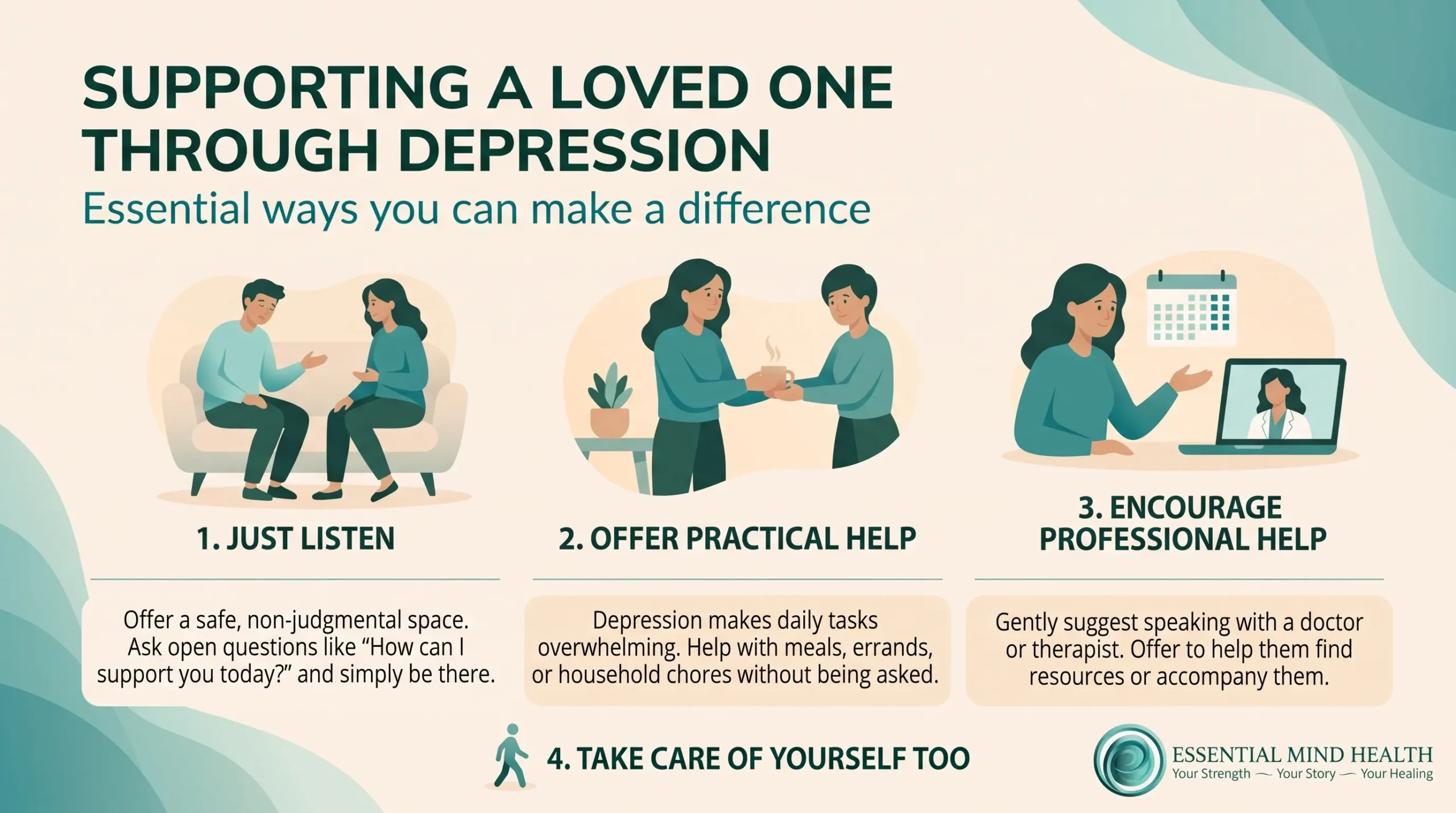
How can you tell it’s depression and not just a rough patch?
You can’t tell for sure, and it isn’t your job to. Only a clinician can diagnose it. What you can do is notice a change that sticks around.
Clinicians look for symptoms that show up most of the day, nearly every day, for at least two weeks, and at least one of them has to be a low mood or a loss of interest or pleasure in things. The usual list includes a sad or empty mood that won’t lift, hopelessness, irritability, guilt or feeling worthless, being tired all the time, trouble concentrating, sleeping or eating differently than before, and aches that have no clear cause. Pulling away from people is common too. So are thoughts about death, which we’ll come back to.
It doesn’t always look like sadness. Someone might seem cranky, short with everyone, or just flat and numb. Older adults may describe feeling emotionally empty and not so much sad. If the person you’re worried about doesn’t seem “down” in the way you’d expect, that doesn’t rule anything out. The less obvious versions are covered in hidden signs of depression and in why depression sometimes shows up as irritability or numbness.
A bad week is a bad week. Everyone has them. But if the change has lasted a couple of weeks or longer, and it’s getting in the way of work, home life or friendships, take it seriously. Sometimes the people around someone notice the shift in mood and behavior before the person does. That’s one reason your read on it counts for something.
What’s the best way to start the conversation?
Pick a quiet, private, unhurried moment. Not in the middle of an argument. Not in front of other people. Not while one of you is halfway out the door. Some people find it easier to talk while they’re doing something side by side, like a walk or a drive, because nobody has to hold eye contact. That’s a guess based on how many people open up that way, not a rule, so go with what suits the two of you.
Say what you’ve actually seen, in plain words, and skip the diagnosis. “I think you’re depressed” can sound like a verdict. Something closer to “You’ve seemed really low the past few weeks, and I’ve been thinking about you” gives them room to answer however they want.
Then ask a question and wait. The waiting is the hard bit. Silence feels awkward, so most of us rush in to fill it with advice. Don’t. Listening without judging, and without handing out opinions nobody asked for, is one of the most useful things you can offer.
They might say “I’m fine.” That happens a lot. Don’t argue or push for details. Try, “Okay. I’m around if that changes.” And then actually follow up in a day or two, with a text or a cup of coffee. One conversation rarely does the whole job. It’s more like opening a door and leaving it unlocked.
What should you say to someone with depression?
Keep it short, warm and low pressure. You don’t need a speech.
A few lines that tend to help: “I’m here.” “You don’t have to explain it to me.” “That sounds exhausting.” “I can’t know exactly what this is like, but I want to understand.” “You matter to me.” Reminding someone of their strengths, and of how much they mean to you and to others, is a simple kind of support that works. Say it plainly and mean it. Skip the pep talk.
It also helps to say what depression is. It’s a health condition. It isn’t a personal flaw or a weakness, and it doesn’t mean they’ve failed at anything. People with depression often feel ashamed and assume willpower should have been enough by now, so hearing that from someone they trust can lighten the load. And it’s okay to tell them it can lift with time and treatment, because it can.
One more thing. When someone’s concentration is shot (a very common symptom), big open questions can feel like homework. “What do you need?” might get a blank stare. Smaller, easier questions often work better. “Do you want company tonight or some space?” “Should I bring food or would you rather I just sit with you?” That’s reasoning from how the symptoms work, not a tested script, but it tends to go well.
What should you never say to someone with depression?
Almost every bad line has the same flaw. It treats depression like an attitude problem. It isn’t one. So anything that sounds like “try harder” is going to feel like blame, however kindly it’s meant.
“Just cheer up.” “Snap out of it.” “Think positive.” These are the obvious ones. The person would love to snap out of it. If they could, they already would have, and being told to do the thing they can’t do tends to add shame on top of everything else. Depression seldom improves through willpower alone.
“It could be worse” and “other people have it so much harder” backfire for a different reason. Guilt and feeling worthless are already symptoms, so comparing them to someone worse off usually just hands them a new reason to feel bad about feeling bad. Same goes for “You have so much to be grateful for.” They probably know that. They may feel awful that gratitude isn’t doing anything.
“Everyone gets down sometimes” shrinks what they’re going through to something ordinary. “I know exactly how you feel” can sound like you’re closing the topic when they were hoping you’d stay in it. “It’s all in your head” misses that depression is a real health condition. And anything that sounds like “You’re being lazy” ignores that low energy and exhaustion are part of the illness, not a lack of effort. The worst one of all is probably “You’re bringing everyone down.” Please don’t ever say that.
Then there’s the advice pile-on: have you tried yoga, a different diet, getting outside, sleeping more? Some of it isn’t wrong. Regular activity, decent sleep and good food do help, and gently encouraging them is a good idea. It’s the delivery that sinks it. A lecture feels like pressure. “Want to walk around the block with me?” feels like company. Same idea, very different ask.
Last, be careful with comments on their treatment. “Do you really need medication?” and “Therapy is a waste of time” can make someone drop care they badly need. If they have worries about a medicine or its side effects, the right place for those is their provider, so encourage them to bring it up there and stay with treatment.
How do you encourage someone with depression to get professional help?
Tell them depression is a health condition, suggest they see a provider, and offer to make it easier. That’s the short version.
A primary care provider is a fine place to start, and so is a mental health provider such as a licensed counselor, psychologist, or psychiatric nurse practitioner. Offer to help find one. Offer to sit next to them while they make the call, since the first call is often the hardest part for someone who’s exhausted and hopeless. Offer to help write down questions for the first visit and, if they’d like it, to go with them. Give a ride if they don’t have one. Small logistics sink more appointments than people admit.
It helps to know what treatment actually involves, so you can answer questions without guessing. It usually means talk therapy, medication, or both. Cognitive behavioral therapy and interpersonal therapy are two common talk therapies. If medication comes up, antidepressants typically take around 4 to 8 weeks to work, which is worth mentioning early so a slow start doesn’t get read as failure. Finding the right approach can take more than one try, too. Some people improve fast, others take longer. If you want the longer version, depression treatment options for adults covers it, and depression treatment response explains why the first thing doesn’t always work.
If they say, “It’ll pass on its own,” you can gently disagree. Depression seldom gets better without treatment and may get worse. You don’t have to scare them. Something like “I’d feel better if you at least talked to someone, and I’ll help set it up” does the job. If they’d like to read something themselves, does depression go away on its own is a good one to send.
For people in the area, there’s depression therapy in Jupiter for in-person visits. And if getting to an office feels like too much, online depression treatment in Palm Beach Gardens and online depression treatment in West Palm Beach are video options for eligible patients. If they’re nervous about what a video visit even looks like, what to expect from online mental health care walks through it.
And if they say no? They’re an adult, and it’s their call. Don’t force it. Let a week or two go by, then bring it up again in a different way, maybe after a better day when they might be more open. You can keep the door open without keeping the pressure on.
What does everyday support look like?
Small, specific and repeated. That’s the whole recipe.
Start with specifics. “Let me know if you need anything” is a kind sentence that puts the work back on the person who has the least energy. Offer a particular thing instead. “I’m dropping off dinner Thursday.” “Can I take the dog out this afternoon?” “I’m going to the store, what do you need?” People can say yes to a specific offer much more easily than they can come up with a request.
A steady routine helps a lot, even a loose one. Regular meals, sleep, medicine if they take it, some movement, a bit of contact with other people. You can help without running their life. Remind them about appointments, check they’ve got a refill, text on a Tuesday to ask if they ate. It’s fairly boring work. It’s also the work.
Keep inviting them to things, gently. Walks, a hobby they used to love, a show on the couch. Expect plenty of “not today,” and don’t take it as a final answer. The invitation matters even when it’s declined, because it tells them they’re still wanted. Just don’t force the issue. Dragging someone to a party they dread is pressure, not support.
Their tiredness is real, too. If they cancel plans a lot, it’s often the illness talking, not a verdict on you or the friendship. What’s behind it is explained in why depression makes you tired, and it’s worth reading before the third cancelled dinner starts to sting.
And be patient. Treatment takes time, and getting well isn’t a straight line. There’ll be better weeks and worse ones. A bad week doesn’t cancel out the progress before it. People can slide back after feeling better, and relapse warning signs are worth knowing about so you can spot a dip early.
What if they push you away, snap at you or cancel on you?
First, know that irritability is a symptom. In some people it’s the main one. Withdrawing is too. So when someone with depression is sharp with you, goes quiet for days or won’t answer your calls, there’s a decent chance the illness is steering and you’re just in the passenger seat.
That’s easy to say and hard to feel. It still stings. A few things help. Keep your messages short and low demand, along the lines of “Thinking of you. No need to reply.” Drop in for a short visit instead of a long one. Don’t keep score of who texted last. And keep inviting, even when the answer has been no five times running.
You’re allowed limits, too. Being understanding isn’t the same as being a punching bag. If the irritability turns into real hurtfulness, you can say, calmly, that you want to help and that you can’t take being spoken to that way. Then step back for a bit and try again later. That isn’t abandoning them. It’s how you stay around for the long haul.
How do you know when it’s an emergency?
If someone with depression talks about wanting to die, feeling like a burden, or having no way out, treat it as urgent. People with depression have a higher risk of suicide, and this is the one area where acting quickly beats being careful about the other person’s feelings.
Warning signs to watch for include saying they wish they were dead or that others would be better off without them, expressing hopelessness or feeling trapped, talking about unbearable pain, looking up ways to die or making a plan, pulling away from everyone, saying goodbyes, giving away belongings, taking dangerous risks, sudden big mood swings, sleeping or eating far more or less than usual, and drinking or using drugs more. Any of these matters most when it’s new, when it’s getting worse, or when it follows a painful event, loss or change.
Ask directly. Something like “Are you thinking about suicide?” is hard to say out loud, and it’s the right question. Studies show that asking people whether they’re suicidal does not increase suicidal thoughts or behavior. It often opens the door instead. Listen to the answer without judging, and don’t argue them out of how they feel.
What to do boils down to five steps. Ask. Be there and listen. Help keep them safe. Help them connect with support. Follow up afterward.
Keeping them safe includes asking whether they have a plan, and then making dangerous means harder to get to. That means locking up or removing firearms, other weapons and medicines. Connecting them means the 988 Suicide and Crisis Lifeline: call or text 988, or chat at 988lifeline.org, any hour of the day. Veterans can call 988 and press 1. You can contact 988 yourself, too, if you’re worried about a friend and want advice on what to do next.
If you think they might hurt themselves right now, call 911 or your local emergency number and stay with them until help arrives. Don’t leave the person alone. Follow-up counts as well. A check-in a day or a week after a crisis keeps them connected, and ongoing contact is one of the things that helps prevent suicide.
How do you look after yourself while helping someone with depression?
You can’t pour from an empty cup. That phrase is a cliché, and it’s also true.
Looking after yourself comes down to three things. Ask other relatives or friends to share the load, and say plainly what you need. Look after your own health: sleep, movement, friends, the things you enjoy. And be patient with the process, because treatment can take a while and may take more than one try.
You’re not their therapist. You’re their friend, partner, sibling or son or daughter. Your job is to be a steady person in their corner and to help them reach care. It is not to carry the whole illness for them. If you notice yourself getting worn down, short-tempered or low, take that seriously. Supporting someone through depression can be heavy, and the weight is real. Talk to someone you trust. If it keeps building, a mental health provider can help you too, and 988 is open to you as well.
Feeling helpless or frustrated now and then doesn’t make you a bad supporter. It makes you someone who cares and who is human. You can read more about the kind of drained feeling that builds up in emotional exhaustion if that sounds familiar.
Where can someone in Jupiter or Palm Beach County get depression care?
Essential Mind Health offers in-person depression care at its Jupiter office for adults 18 and older. The first visit includes a full evaluation. Care is led by Jennifer Caschetta, PMHNP-BC, a board-certified psychiatric mental health nurse practitioner. Visits can include a depression evaluation, medication management and talk therapy, including CBT and IPT, and lifestyle support around sleep, nutrition, movement and routine. The practice treats major, persistent, seasonal, postpartum, bipolar and atypical depression, as well as depression that comes with anxiety or poor sleep. You can read more on the depression therapy in Jupiter page.
If someone would rather not travel, or the idea of leaving the house feels like too much, secure video visits are available to eligible patients across Florida. There are dedicated pages for online depression treatment in Palm Beach Gardens and online depression treatment in West Palm Beach. For a wider look at what’s offered nearby, see mental health care in Palm Beach Gardens and mental health care in West Palm Beach. And if you’d like to know who they’d be seeing, meet the provider tells you.