

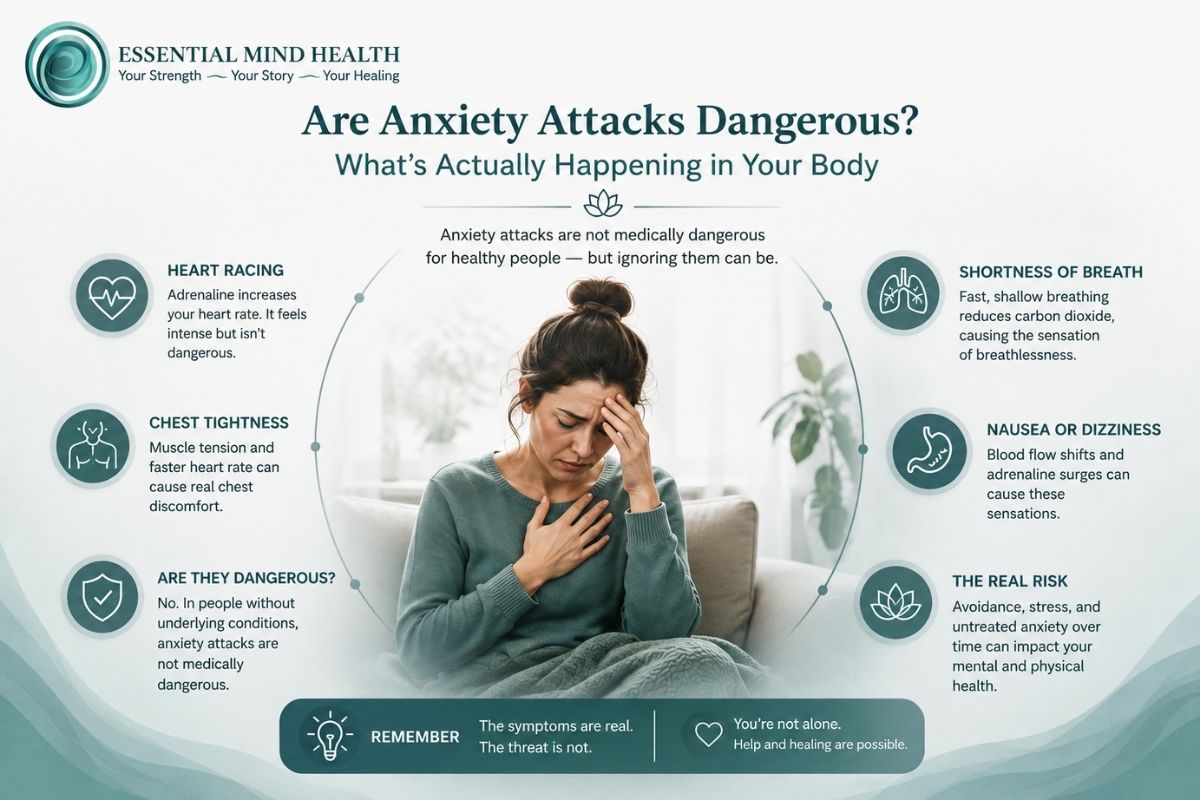
No anxiety attacks are not medically dangerous to people without an underlying cardiac or respiratory condition. The symptoms are real, intense, and genuinely frightening, but an anxiety attack cannot cause a heart attack, cannot stop your heart, and cannot cause you to stop breathing even though it can feel exactly like all of those things are happening. What makes anxiety attacks so distressing is not what they actually do to the body, but what they cause the brain to believe is happening while they occur. Understanding the distinction between what feels dangerous and what is dangerous is the first step toward the anxiety attack having less power over you and toward addressing the pattern before it becomes something that does carry real risks.
Medical note: Chest pain, shortness of breath, and racing heart can be symptoms of serious medical conditions unrelated to anxiety. If you are experiencing these symptoms for the first time, if they are severe or worsening, or if you have any cardiac risk factors, seek emergency medical evaluation before attributing symptoms to anxiety. Do not use this article to self-diagnose.
Why the Question Matters and Why the Answer Is More Complicated Than “No”
Most articles on this topic answer “are anxiety attacks dangerous?” with a reassuring no and move on. The reassurance is accurate but incomplete, because it addresses the wrong part of the question.
An anxiety attack in the moment does not endanger your physical health if you are otherwise healthy. That part is straightforwardly true.
But anxiety attacks that recur, that go unaddressed, and that produce the avoidance and behavioural changes that most people develop in response to them do carry real consequences. The danger is not in a single anxiety attack. It is in what anxiety attacks do over time to how you live the situations you avoid, the relationships that narrow, the life that contracts around the effort to prevent the next one.
That is where the real risk lives, and it is the part worth understanding clearly rather than skipping past.
What Is Actually Happening in Your Body During an Anxiety Attack
The experience of an anxiety attack, heart racing, difficulty breathing, chest tightness, dizziness, a sense of impending doom is produced by a genuine, measurable physiological event. The amygdala, the brain’s threat-detection centre, has fired an emergency signal that activates the sympathetic nervous system and triggers the release of adrenaline and cortisol throughout the body.
This is the fight-or-flight response, the same biological mechanism that evolved to protect humans from physical threats. It was designed to prepare the body for immediate action: heart rate increases to push more blood to the muscles, breathing becomes faster and shallower to increase oxygen availability, blood vessels constrict to redirect blood flow, and muscles tense in preparation for exertion.
Every one of these changes is physiologically appropriate for a genuine physical emergency. In an anxiety attack, they occur in the absence of a physical emergency which is why the gap between what the body is doing and what the conscious mind can see in the environment around it feels so alarming.
Heart Racing and Palpitations
Adrenaline increases heart rate rapidly and significantly. A heart that was beating at 70 beats per minute can accelerate to 120, 140, or higher during an acute anxiety response. This is not dangerous in a healthy heart, it is the same acceleration that occurs during vigorous exercise. The difference is context: when your heart rate spikes during a run, it makes sense. When it spikes while you are sitting at your desk or lying in bed, the absence of an obvious cause makes the sensation alarming.
The heart is not under threat. It is doing precisely what adrenaline tells it to do, working harder in preparation for a demand that never comes.
Chest Tightness and Chest Pain
Chest pain during an anxiety attack is real and is produced through multiple simultaneous mechanisms. The muscles of the chest wall the intercostal muscles between the ribs, the muscles of the sternum tighten significantly under the stress response. Sustained tension in these muscles produces genuine pain and pressure that can be intense and localised.
Additionally, the rapid change in heart rate and the constriction of peripheral blood vessels produces sensations in the chest that overlap significantly with cardiac symptoms. This overlap is not coincidental; the physiology of the stress response and the physiology of certain cardiac events share some of the same downstream effects.
The important distinction: the chest pain of an anxiety attack is produced by muscle tension and physiological arousal in a healthy cardiovascular system. It is not produced by reduced blood flow to the heart muscle. It does not indicate cardiac damage. But this cannot be overstated chest pain that is new, severe, or associated with cardiac risk factors requires medical evaluation, not self-reassurance.
Shortness of Breath and the Feeling of Not Being Able to Breathe
This is one of the most distressing and most misunderstood symptoms. During an anxiety attack, breathing becomes faster and shallower in response to adrenaline. This hyperventilation pattern reduces carbon dioxide levels in the blood, producing a shift in blood chemistry called hypocapnia.
The paradox of hyperventilation is that breathing faster, which feels like the correct response to not getting enough air, actually makes the sensation of breathlessness worse. The feeling of not being able to get a full breath is produced by the chemical changes from over-breathing, not by an actual reduction in oxygen. Oxygen levels remain normal or even slightly elevated during hyperventilation. The sensation is real; the mechanism producing it is the opposite of what it appears to be.
Dizziness and Feeling Faint
The same blood flow shifts that produce chest sensations also temporarily affect blood flow to the brain. Combined with the blood chemistry changes from hyperventilation, this produces genuine dizziness and lightheadedness sometimes intense enough to create a genuine fear of fainting.
People almost never actually faint during an anxiety attack. Fainting occurs when blood pressure drops suddenly the opposite of what happens during the high-arousal state of an anxiety attack, when blood pressure is elevated. The sensation of nearly fainting is produced by the altered blood flow and blood chemistry; the actual event does not occur.
The Sense of Unreality and Impending Doom
Two specific experiences during anxiety attacks derealization (the world seeming unreal or distant) and depersonalization (feeling detached from one’s own body or thoughts) are among the most disturbing aspects for many people.
These experiences are produced by the brain’s attempt to process an overwhelming amount of internal physiological information simultaneously. The threat-detection system has fired at maximum intensity; the brain is monitoring the heart, the lungs, the muscles, the environment, and its own processing all at once. The result is a kind of overload that produces the sense of unreality.
Alongside this is the sense of impending doom, a feeling that something catastrophic is about to happen that does not correspond to anything visible in the environment. This is not irrational thinking. It is the direct subjective experience of the amygdala having classified the current moment as an emergency. The feeling is a product of the emergency signal, not evidence of an actual emergency.
Why Anxiety Attacks Feel Like Dying
The specific experience of believing you are dying during an anxiety attack is not dramatic exaggeration. It is what the amygdala’s emergency signal actually produces when the body interprets the physiological experience as a medical event rather than an anxiety response.
When you cannot breathe, your heart is racing, your chest hurts, you are dizzy, and the world feels unreal the most available interpretation, particularly for someone who has not experienced an anxiety attack before and has not been told what it is, is that something is seriously physically wrong.
The fear of dying that accompanies many anxiety attacks is the brain accurately reporting that it has assessed the current situation as life-threatening. The assessment is wrong. The situation is not life-threatening but the report is a genuine product of the threat-detection system doing what it was designed to do.
This is also why reassurance from people around you often does not help in the moment. The amygdala’s assessment of danger is not updated by verbal information when it is in a state of maximum activation. The body is already committed to the emergency response.
The Real Dangers: What Actually Carries Risk
If anxiety attacks themselves are not medically dangerous, where does the genuine risk live?
The Secondary Cycle: Fear of the Fear
The most significant risk from an anxiety attack is not the attack itself, it is what happens afterward. Once someone has experienced the overwhelming physical intensity of an anxiety attack, the nervous system learns to treat that experience as a threat. The anticipation of another attack becomes its own trigger, producing a state of monitoring and hypervigilance that keeps the nervous system in a partially activated state.
This is the mechanism behind panic disorder, the established pattern in which anxiety about having an anxiety attack becomes the primary driver of further attacks. The original external trigger becomes less relevant; the fear of the internal experience is what sustains the cycle.
Avoidance: The Mechanism That Narrows Life
The most consistent behavioural consequence of recurrent anxiety attacks is avoidance. People stop going to places where attacks have occurred, certain stores, highways, social gatherings, public transport and gradually stop doing activities that raise the heart rate or produce sensations that resemble the onset of an attack. Exercise is often abandoned. Social life contracts. Professional opportunities are declined.
Each act of avoidance provides immediate relief and teaches the brain that the avoided situation was genuinely dangerous, strengthening the threat association rather than extinguishing it. Over time, the accumulation of avoidance can produce a life organised around preventing anxiety rather than engaging with what matters in it.
This narrowing is the most clinically significant consequence of untreated anxiety attacks more so than any individual attack’s physical effects.
Physical Health Over Time
Chronic anxiety, the sustained physiological activation of the stress response that often accompanies recurring anxiety attacks, does carry real physical health implications over time. Elevated cortisol affects immune function, sleep quality, and cardiovascular health when sustained over months and years. Chronic muscle tension produces pain and fatigue. Sleep disruption from anxiety affects every system in the body.
These are not consequences of any single anxiety attack. They are the consequences of an anxiety pattern that has not been treated and that has kept the body’s stress systems running at an elevated level continuously.
When to Seek Medical Evaluation Not Reassurance
This distinction is important: there is a difference between seeking medical evaluation and seeking reassurance.
Reassurance being told by someone that it is “just anxiety” without any actual evaluation is not the same as a medical assessment. People with anxiety have heart attacks. People having heart attacks have anxiety. The symptoms overlap genuinely, and self-diagnosis based on past experience with anxiety is not a substitute for evaluation when symptoms are new, changing, or severe.
Seek emergency medical evaluation if:
- Chest pain is new, severe, crushing, or radiating to the arm or jaw
- Shortness of breath is severe or not resolving after the acute episode
- You have known cardiac risk factors family history of heart disease, high blood pressure, diabetes, smoking history
- You lose consciousness or nearly do
- Symptoms are significantly different from previous episodes
Once cardiac and other medical causes have been ruled out, which is the appropriate sequence, recurring anxiety attacks with chest pain, breathlessness, and palpitations can be attributed to anxiety and addressed through anxiety treatment.
The Relationship Between Anxiety Attacks and Depression
Anxiety attacks rarely occur in isolation for long. The experience of recurring anxiety attacks the fear of the next one, the behavioural avoidance, the narrowing of life is itself depressing. The loss of activities, the social withdrawal, the sustained exhaustion of chronic arousal all contribute to depressed mood.
This is one of the most common pathways through which anxiety and depression co-occur the anxiety comes first, the depression follows the avoidance and loss that the anxiety produces. Treating the anxiety without addressing the depression that has developed alongside it produces incomplete recovery.
Our post on whether anxiety and depression are related covers the co-occurrence in detail including why treating one without the other is often less effective than addressing both.
What Actually Helps
Understanding What Is Happening
Psychoeducation understanding the physiology of what anxiety attacks actually produce and why the symptoms feel the way they do consistently reduces their power. This is not because understanding eliminates the physiological response. It is because the secondary layer of fear the fear of the fear, the interpretation of physical sensations as evidence of a medical emergency is driven by not knowing what is happening. When you understand that the racing heart is adrenaline, not cardiac damage, the interpretation changes and a changed interpretation reduces the secondary amplification.
The Physiological Sigh
The fastest accessible intervention during an anxiety attack is a targeted breathing technique: a double inhale through the nose followed by a long, slow exhale through the mouth. This activates the parasympathetic nervous system directly by slowing the heart rate via the vagus nerve and begins to reverse the hyperventilation-driven blood chemistry changes that are producing some of the worst sensations.
The extended exhale is the critical element. The normal instinct during breathlessness is to inhale more deeply and rapidly which worsens hyperventilation. Deliberately extending the exhale is the physiologically correct counterintuitive response.
Not Escaping
Leaving a situation during an anxiety attack provides immediate relief and directly teaches the brain that the situation was the source of danger. The relief itself is the reinforcement the nervous system records that escape worked, which makes escape more likely next time and makes the anxiety about that situation larger.
Staying in the situation, allowing the attack to peak and naturally resolve, provides a different signal that the situation was survivable, that the body’s emergency response can activate and resolve without catastrophe. This is the principle underlying the exposure component of effective anxiety treatment. It is one of the hardest things to do in the middle of an attack and one of the most important.
Professional Treatment
Anxiety attacks that are recurring, that have produced avoidance, and that have been present for weeks or months are very unlikely to resolve without professional support. The maintaining cycle fear of attacks producing hypervigilance, hypervigilance producing more attacks, avoidance reinforcing the danger assessment does not break spontaneously.
Effective treatment addresses the cycle rather than individual symptoms. Our existing post on Why Does Anxiety Cause Physical Symptoms and our Anxiety service page cover the treatment approaches we use at Essential Mind Health including the specific methods that have the strongest evidence for anxiety attacks and panic disorder specifically.
If you’re wondering whether what you’re experiencing is a temporary low mood or a longer-lasting depressive episode, our guide on how long a depressive episode typically lasts can help you understand what to expect, how symptoms may change over time, and when it may be time to seek professional support.