
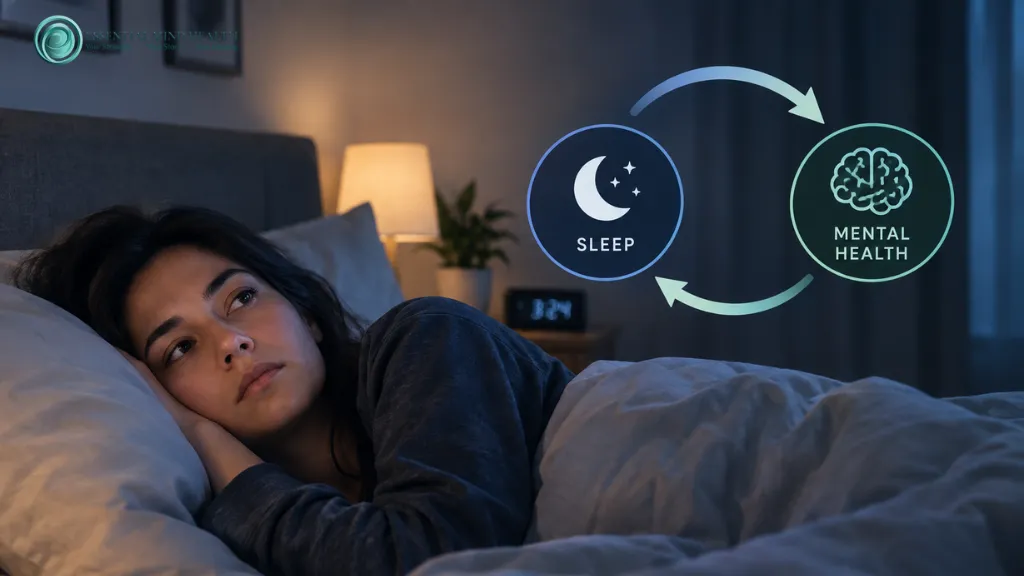
“I can’t tell anymore if I’m anxious because I’m not sleeping, or not sleeping because I’m anxious.” That sentence comes up constantly, and there’s a real reason it’s hard to answer. Sleep and mental health don’t sit next to each other as two separate problems. They run through the same systems in the brain, and once one starts slipping, the other usually follows close behind. Untangling which came first matters less than understanding how the loop actually works, and what actually breaks it.
How sleep loss and mental health actually connect
Poor sleep isn’t just tiredness. It disrupts the same brain regions involved in mood regulation, emotional processing, and stress response, the amygdala, the prefrontal cortex, the systems that normally help someone put a bad day into perspective instead of spiraling on it.
After a few nights of poor sleep, the amygdala, the brain’s threat detection center, becomes more reactive, while the prefrontal cortex, which normally keeps that reactivity in check, becomes less effective at doing its job. The practical result is that ordinary stress starts to feel bigger than it actually is. A minor setback that would barely register on a well rested day can feel overwhelming after a stretch of bad sleep, not because the setback changed, but because the brain’s capacity to regulate the response to it took a hit.
Which comes first, anxiety or insomnia
Genuinely either one, and it often doesn’t matter which started the cycle once it’s running.
Anxiety keeps the nervous system activated in ways that make falling asleep and staying asleep difficult, racing thoughts, physical tension, a mind that won’t downshift even when the body is exhausted. Meanwhile, sleep loss on its own increases anxiety symptoms, more worry, more irritability, a lower threshold for feeling overwhelmed, even in people with no prior anxiety history. Each one feeds the other. Someone can start anxious and lose sleep because of it, or start with poor sleep for an unrelated reason, jet lag, a new baby, shift work, and develop anxiety symptoms as a downstream effect. By the time someone’s in the middle of it, the starting point is mostly academic. The loop is what needs addressing.
Does the same thing happen with depression
Yes, and the connection runs even deeper here. Disrupted sleep is actually one of the diagnostic criteria for major depressive disorder, not just a common side effect of it.
Depression can show up as sleeping far too much or far too little, and both patterns are common. Poor sleep, in turn, worsens depressive symptoms, low energy, difficulty concentrating, a flatter emotional range. There’s also a well established finding that persistent insomnia is a real risk factor for developing depression in the first place, not just something that shows up after depression starts. That relationship runs in both directions strongly enough that some sleep researchers treat insomnia treatment as a meaningful piece of depression prevention, not just symptom management after the fact.
What about conditions where sleep disruption is part of the picture itself
Some conditions carry sleep disruption as a core feature, not a side effect.
PTSD frequently comes with nightmares, hypervigilance at night, and a nervous system that stays on alert even during rest, all of which make deep, restorative sleep hard to reach. PTSD treatment that doesn’t address the sleep piece directly tends to leave a significant chunk of the condition’s daily impact untouched, since exhaustion on top of trauma symptoms compounds both. Bipolar disorder has its own distinct relationship with sleep, reduced need for sleep during manic or hypomanic episodes, and disrupted sleep during depressive ones, and sleep disruption itself can actually trigger or worsen mood episodes in bipolar disorder specifically, which makes sleep tracking a genuinely useful early warning sign for bipolar disorder treatment, not just a comfort issue.
Why does one bad night feel manageable, but a pattern doesn’t
Because the brain and body can absorb short term sleep debt reasonably well. It’s the accumulation that causes real damage.
A single rough night mostly just leaves someone tired the next day. A pattern of poor sleep over weeks starts compounding in ways that are harder to shake off with one good night’s rest. Emotional regulation gets progressively worse. Cognitive function, memory, focus, decision making, takes a real hit. Physical health markers start shifting too, blood pressure, inflammation, immune function, all of which loop back and affect mood and mental health further. That’s part of why someone who’s been sleeping poorly for months often can’t just “catch up” over a weekend the way people sometimes expect. The debt built up gradually, and it tends to resolve gradually too, not all at once.
What actually breaks the cycle, since it clearly isn’t just trying to sleep more
Treating both sides at once tends to work better than treating either alone, mainly because a mental health condition that’s actively driving poor sleep will usually keep disrupting it even if someone works hard on sleep hygiene by itself.
Cognitive behavioral therapy for insomnia, often shortened to CBT-I, has strong research support and specifically targets the thought patterns and habits keeping sleep disrupted, worry about not sleeping, checking the clock repeatedly, spending too much time in bed awake. It’s considered a first line treatment for chronic insomnia, often more effective long term than sleep medication alone. Alongside that, treating the underlying anxiety, depression, PTSD, or bipolar disorder driving the disruption in the first place addresses the other half of the loop. Neither piece alone tends to fully resolve it when both are actually present.
Does medication help, or does it just mask the problem
It depends heavily on what’s actually being treated and how the medication is being used.
Sleep medication used as a standalone, long term fix, without addressing what’s driving the sleep disruption, tends to lose effectiveness over time and doesn’t address the underlying mental health piece at all. Used short term, to break an acute cycle while therapy or another treatment takes effect, it can genuinely help someone get enough rest to actually engage with that other work. Certain antidepressants and anti anxiety medications also have secondary effects on sleep, some more sedating, some more activating, and that’s often part of what a provider considers when choosing between options for someone whose sleep and mood are both disrupted at once.
What actually helps day to day, beyond treatment itself
A few things make a real difference alongside formal treatment. Consistent wake time matters more than consistent bedtime, oddly enough, since a stable wake time anchors the body’s internal clock more reliably than trying to force sleep at the same hour every night. Limiting time in bed while awake helps too, since the brain starts associating the bed with wakefulness and frustration the more time gets spent there tossing and turning. Screens before bed matter less than the internet consensus suggests for most people, but the content matters more, doom scrolling anxiety inducing news at midnight does more damage than the blue light itself. And caffeine’s half life is longer than most people assume, six hours or more for a lot of people, which means an afternoon coffee can still be affecting sleep at midnight without anyone connecting the two.
Does age or life stage change how this plays out
Somewhat. Teenagers naturally run on a delayed sleep cycle biologically, which combines badly with early school start times and can create a chronic sleep debt that shows up looking like mood or attention problems rather than a sleep issue on the surface. New parents deal with fragmented sleep that isn’t really insomnia in the clinical sense but produces a lot of the same downstream effects, irritability, low mood, trouble concentrating, simply from the pattern being broken night after night. Older adults naturally experience lighter, more fragmented sleep as a normal part of aging, which can make it harder to tell what’s an expected age related shift versus a treatable sleep or mood problem layered on top of it. None of this means the underlying mechanism changes. It means the presentation and the practical fixes look a little different depending on what’s driving the disruption at that life stage.
Can exercise or diet actually move the needle here
To a real but limited degree. Regular physical activity, especially earlier in the day, tends to improve both sleep quality and mood independently, which makes it one of the few interventions that helps both sides of the loop at once rather than just one. Exercise too close to bedtime can work against sleep for some people though, since it raises core body temperature and alertness right when the body’s trying to wind down.
Diet’s effect is smaller than a lot of wellness content suggests, but not nothing. Heavy meals close to bedtime, alcohol, which fragments sleep even though it can help someone fall asleep initially, and irregular meal timing can all nudge sleep quality in the wrong direction. None of this replaces actual treatment for anxiety, depression, or a sleep disorder, but it’s a real piece of the picture worth getting right alongside whatever else is happening in treatment.
How does someone know if it’s time to get real help instead of just trying harder
A rough patch tied to something specific, a stressful week, travel, a temporary life disruption, usually resolves on its own within a couple weeks once the trigger passes.
Sleep disruption that’s lasted longer than a month, that’s paired with a noticeable mood change, more irritability, more worry, less interest in things, or that’s started affecting work, relationships, or daily functioning, is worth bringing to a provider rather than continuing to wait it out. The earlier that loop gets addressed, the less momentum it builds, and the easier it tends to be to break.
What This Looks Like at Essential Mind Health
Mental health care in Palm Beach Gardens at Essential Mind Health starts by looking at sleep and mood together, since treating one while ignoring the other usually leaves the cycle intact. Online insomnia treatment addresses the sleep disruption directly, while online anxiety treatment and online depression treatment work on whatever’s driving it from the other direction, so both sides of the loop get addressed at the same time instead of one at a time.
Disclaimer: This content is for general informational and educational purposes only and should not be considered professional medical advice. Always consult a qualified healthcare professional for advice regarding your individual health or treatment.
Quick answers
Does poor sleep actually cause anxiety and depression, or just make them worse?
Both. Poor sleep can trigger anxiety and depressive symptoms on its own, and persistent insomnia is a real risk factor for developing depression, not just a symptom that shows up after it starts.
Which comes first, anxiety or insomnia?
Either one, and once the cycle is running it usually doesn’t matter which started it. Anxiety disrupts sleep, and sleep loss increases anxiety, feeding each other either direction.
What actually breaks the cycle?
Treating both sides together tends to work best. CBT-I addresses the sleep piece directly, while treating the underlying anxiety, depression, PTSD, or bipolar disorder addresses what’s driving the disruption in the first place.
Does sleep medication fix the problem?
Long term use as a standalone fix tends to lose effectiveness and doesn’t address the underlying cause. Used short term alongside other treatment, it can help someone get enough rest to actually engage in that work.
When is it time to get help instead of waiting it out?
When sleep disruption has lasted more than a month, comes with a noticeable mood change, or starts affecting work or relationships. The earlier it gets addressed, the easier the cycle is to break.